Monthly Archives: November 2017

2018 Book List

2018 Book List

Ann – December 7
***Wonder – R.J. Palacio

Josee – April 12
***The Break – Katherina Vermette

Karen – January 18
***The Hearts of Men – Nicholas Butler
Beautiful Animals – Lawrence Osborne
The Girls – Emma Cline

Jane – March 1
***Lincoln in the Bardo – George Saunders
House without Windows – Nadia Hashimi

Laura – September 27
Mennonite in a Little Black Dress
Eleanor Oliphant is Completely Fine
***Between the World and Me – Ta-Nehisi Coates

Bev – December 6
***Do Not Say We had Nothing – Madeleine Thien
The Last Neanderthal – Claire Cameron
The Lake House – Kate Morton

Jeanne – November 8 (Note: Date Change and book change!)

*** Educated by Tara Westover

***Born a Crime – Trevor Noah

What Happened – Hillary Clinton

Waking the Frog – Tom Rand

Erin – March 7, 2019

***Becoming – Michelle Obama

Jill: January 24 2019

The Childhood Jesus – J. M. Coetzee

Moira: May 2, 2019

A Gentleman in Moscow – Amor Towles

πŸ“šπŸ“šπŸ“šπŸ“šπŸ“šEVERYONE IS TO BRING THEIR BOOK SELECTIONS FOR THE NEXT YEAR TO MOIRA’sπŸ“šπŸ“šπŸ“šπŸ“šπŸ“š

1 Comment

Filed under Book Lists

I Know Why The Caged Bird Sings by Maya Angelou November 2017 at Erin’s

IMG_20171102_2105135.jpg

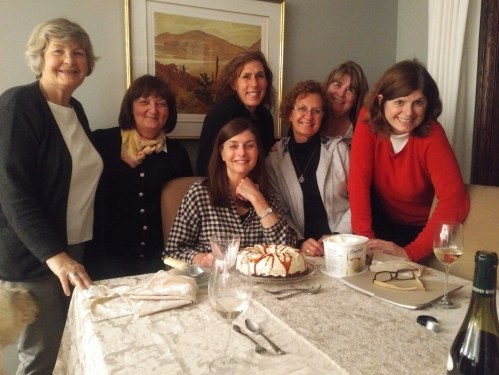
A lovely fall evening at Erin’s discussing Maya Angelou and her autobiography I Know Why the Caged Bird Sings

Erin used recipes from Maya Angelou’s cookbook and made us a southern feast:

Roasted chicken, salad, sweet potatoes and buttermilk biscuits to die for followed by an over the top amazing caramel cake with extra caramel sauce to drizzle on top!!!

This “morning after” message from Karen expresses the evening and the powerful storytelling of Maya Angelou:

Good Morning All, Firstly I want to thank Erin for suggesting our book and introducing me to Maya Angelou.  I think we can all agree on the power of her storytelling, her ability to take us into her world, a world that is both joyous and painful and most of all keenly felt.  A remarkable woman whose work I may not have read if it wasn’t for our beloved book club.

And thanks Erin for hosting such a delicious evening (please pass along those recipes).  Your home is so comfortable and welcoming (thanks also to Dexter!).  All in all a very special night.

By the way, you may remember I mentioned that Maya had appeared on Charlie Rose.  I found this 13 minute compilation of his favourite interviews.  It is worth watching as it includes a visit to Stamp and the infamous walk from the pond to the railroad tracks and the white side of town.

https://charlierose.com/videos/17765

From Bev:
And may I add my thanks to you, Erin for a wonderful evening. And thank you for suggesting such a wonderful book and author. It is truly amazing in a  world that seems to have gone mad to hear this eloquent, quiet voice who frames her experiences with words so beautifully crafted and so powerful.  A gem.

After the book discussion we discussed the next cycle book list. Ann’s bookclub December 7th is the last for this cycle. The book is Wonder by R. J. Palacio.

Karen was prepared enough to bring her choices (and it was a very difficult decision to choose!!)

IMG_20171102_2128417.jpg

Recipes

http://greatideas.people.com/2014/05/28/maya-angelou-cookbook-buttermilk-biscuit-recipe/

Rob Schoenbaum/AP. Since her death on Wednesday at age 86, Maya Angelou has been hailed as an award-winning poet, best-selling author and fearless civil …

http://abcnews.go.com/GMA/recipe?id=13528375

Maya Angelou prepares sweet potatoes McMillan from her cookbook “Great Food, All Day Long: Cook Splendidly, Eat Smart.”

http://www.oprah.com/food/maya-angelous-caramel-cake-recipe

Get the recipe for Caramel Cake from Dr. Maya Angelou’s cookbook ‘Hallelujah! The Welcome Table: A Lifetime of Memories with Recipes.’


Leave a comment

Filed under Book Club Meetings

Coppermine by Keith Ross Leckie September 2017 at Moira’s

Moira hosted our first book after the summer. Starting with an outstanding charcuterie board in her lovely basement we watched a video of the Coppermine area. (Link should be attached here soon)

Dinner (not raw fish to the relief of all) was a delicious pot roast, roasted vegetables and a peach crisp with ice cream for dessert.

A couple reviews about book Coppermine:

“Part epic adventure, part romance, and part true-crime thriller, Coppermine is a dramatic, compelling, character-driven story set in 1917 in the extremes of Canada’s far north and the boom town of Edmonton.

The story begins when two missionaries disappear in the remote Arctic region known as the Coppermine. North West Mounted Police officer Jack Creed and Angituk, a young Copper Inuit interpreter, are sent on a year-long odyssey to investigate the fate of the lost priests. On the shores of the Arctic Ocean near the mouth of the Coppermine River, they discover their dismembered remains. Two Inuit hunters are tracked and apprehended, and the four begin an arduous journey to Edmonton, to bring the accused to justice.”

Goodreads

For a nation as enormous, wild and relatively unpeopled as Canada, we write remarkably few adventure stories. Grief, nostalgia, immigration, family secrets – we’ve definitely got some things nailed down. But adventure? Visceral, bruising, wilderness thrills? Not much. Especially given that we’ve got so much potential material to work from. It’s like imagining the literature of New York neglecting the city and focusing on Central Park. On a Sunday night. In a blizzard.

There are exceptions, of course. Farley Mowat spun some dandy snowbound cliffhangers. Jack London, though American, did a lot of drinking and writing in the Yukon. But in the last 20 years? The last 40? There are as many Holocaust allegories involving animals as there are tundra thrill-rides. In fact, the most successful recent northern Canadian gripper (at least of the historical variety) is likely The Tenderness of Wolves, by Stef Penney, a Scottish screenwriter who, prior to the book’s publication, had never even visited Canada.

It is welcome, then, to find Keith Ross Leckie’s Coppermine portaging into the world. Like Penney, Leckie is a screenwriter (CBC miniseries including Mowat’s Lost in the Barrens) and, like Penney, situates his narrative in the past. However, unlike Penney’s book, this one proceeds from true events (more or less).

In 1917, the first juried criminal trial of Inuit in Canada was a media sensation, the press of the time referring to the occasion as “modern law meets Stone Age man.” The crime? Two priests who had headed into the Coppermine region of the Northwest Territories disappeared four years earlier, and were later discovered murdered. The accused – two Inuit hunters – were apprehended by a young NWMP officer and delivered south to Edmonton to face charges.

It is a gift of a premise: initiating mystery, physical action, epic journeys, complicated justice, clash of cultures. For the most part, Leckie exploits these ingredients in tasty ways, his scriptwriting craft showing in sure pacing and brisk scenes ending with snap! crackle! pop! buttons. His Mountie, Creed, is a solid if stock protagonist, a canoe-loving man of duty who prefers the relative certainties of solitude and the law over the puzzles of the heart.

He is Canadian in other ways, too: When he discovers that his Inuinnaqtun interpreter, a boy named Angituk McAndrew, is in fact a warm-hearted and good-cooking girl who has a thing for him, he resists the temptation for some fun under the skins with near super-human restraint. It’s not that he’s a married man, either. It just wouldn’t be right.

The question of what is right comes into play in more interesting ways, at least anthropologically speaking, in Coppermine‘s second half, after Uluksuk and Sinnisiak, the two accused, are finally brought to Edmonton for trial. Leckie traces the legal tactics of a prosecution and defence challenged by a case where the confessed murderers believed they were justified in killing the priests because they represented evil spirits come to bedevil their people (an accurate assessment in hindsight). He also dramatizes the local excitement of seeing “real Eskimos” processed by white understandings of motive, of civility, of taboo – not to mention eating candy and taking elevator rides – for the first time.

But while Coppermine is an agreeable and well-assembled drama, it is ultimately televisual in both its pleasures and its superficiality. This is, in part, the fault of Leckie’s prose, which while always competent, rarely casts a spell beyond the smooth relating of interesting events. But it is also the lack of depth the novel brings to any one of its points of view. Is the world of Coppermine seen through Creed’s eyes? If so, we don’t get to know him much beyond that of a decent Mountie whose “arc” is to develop warm (if anachronistically modern) cultural sensitivities. His eye is less important than his function, and this limits how far we can go with him, how real he feels.

What Coppermine gets right remains the more essential elements of the adventure story: suspense, stakes, clear resolution. Even the story’s potential ambiguities of “good guy” and “bad guy” get swiftly tidied up, leaving us on solid ground throughout. It is a work of entertainment, in other words.

Yet it is intriguing to consider how another authorial hand might treat the same material, an approach that deepened its voices and ambiguities. Because while the greatest adventure stories take place in the outside world, they gain their power when they use their thrills to reveal something new when we look within.

Andrew Pyper is the author, most recently, of The Killing Circle. His new novel, The Guardians, is to be published in January.

Leave a comment

Filed under Book Club Meetings