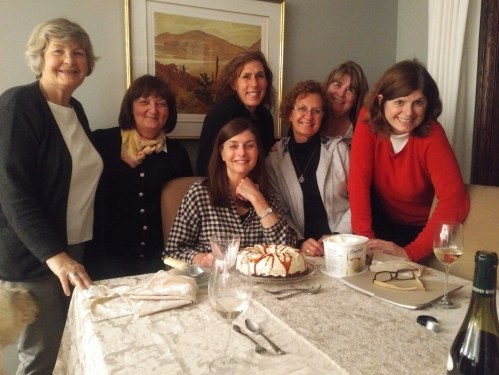
Author Archives: cjeanneb

The Break by Katherena Vermette at Josee’s April 12th 2018

Tulips and warm light on a spring evening greeted us at Josee’s (just before winter set in again – interjection –  a little reminder to everyone about the book Waking the Frog (not that ice storms in April are unheard of but…)

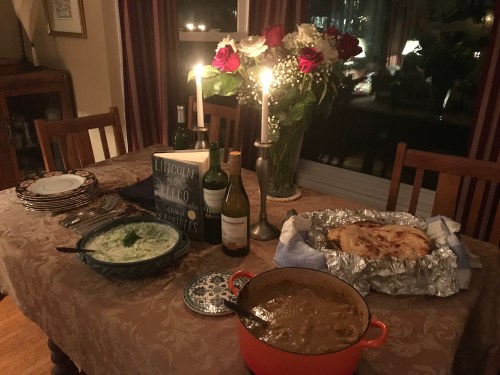
Josee’s table was magic; in the fading light from the sun it looked like a masterpiece from another century! The indigenous inspired dinner; bannock, three sister’s vegetable salad, wild rice with pumpkin seed, blueberries and mushrooms, maple baked salmon was superb. As the room darkened and the wine and food were enjoyed we discussed the book as we always do, with gusto!! A pleasure everyone of us made it to Josee’s.

All agreed Katherena Vermette’s book was a must read despite the horrific abuse it contained. The author was a poet first and The Break was extremely well written and (aside from the challenging subject matter) an excellent read. It seemed to have brought up thoughts in many of us about our fears and what we would do in situations where to help someone could mean ourselves and/or our family would suffer. We discussed the abuse to a group of people, from both within their culture and from society as a whole and that this is not an isolated story but pervasive and systemic in Canada ever since the “white/European/British empire” settlers discovered, colonized and tried to “assimilate” the people here before them.  We discussed the strength and connection of the women in the story, generations of nurturing, strong women supporting each other and this may be the only hope. We talked about the power of this story; that it portrayed both victims and abusers in a way that it was possible for us to feel empathy and compassion for both. And the incredible sadness of the reality that babies are being conceived and brought up not knowing anything other than the cycle of abuse and numbing.

Comments and links:

Here is the link to the  video I shared yesterday.  I know it was hard to hear but I think it is a worthwhile video to see.  Thanks for a lovely gathering of the minds last night. It is always something to look forward to. Ann

Thanks Jose for hosting last night.  I particularly enjoyed your research into Katherena Vermette’s life and work.  What an inspiring woman!  And kudos to you for preparing a delicious meal too.  Hopefully your recipes will be posted on our blog.

Sadly our inability to accept indigenous peoples – their culture, their history and their rightful place in Canadian society, has still a long way to go.  Coincidently in today’s Globe and Mail Stephanie Nolan has written an article about Uruguay’s native community fighting for similar rights.  How timely.  It seems the human species has a difficult time accepting “otherness”

https://www.theglobeandmail.com/world/article-in-uruguay-indigenous-people-are-fighting-to-prove-they-exist/

Josee, thank you for choosing a book that gave heart rending insight into the personal complexity, plight and hardships of indigenous women, but to all accounts, all indigenous people.
It was truly an enlightening evening for me, and as I mentioned, brought back memories of the time I visited Kenora in 1969 and saw the plight of the indigenous men on the streets. Has so much changed after all these years? Jill

Katherena Vermette, winner of the 2013 Governor-General’s Literary Award for Poetry, deftly crosses genres into the world of prose with her new novel, The Break.

The Break starts as so many stories do: A girl is raped. In a deserted, snow-covered field called “The Break” in the North End of Winnipeg, a 13-year-old Métis girl is raped in the night, while a mother, holding her crying baby, watches from her window.

Thus Katherena Vermette’s triumphant debut novel kicks off much like a police procedural: Who did this and why?

These simple narrative questions offer much pleasure, especially in terms of suspense and pacing, as anyone who likes a good plot can attest (and, indeed, the book is impossible to put down). But they also act as support beams for the incredible feat of storytelling Vermette pulls off: The novel is told from 10 characters’ points of view, some told in first person, some in third, some alive, some dead, some girls, some women and one lone male voice: the Métis officer investigating the case. Seven of the voices are related to one another, and much of the joy of this novel comes from piecing this family together. (There is, thankfully, a family tree at the beginning of the book). By stitching the story together in this way, Vermette introduces a third narrative mystery: Which one of these voices is the raped girl? Will she tell her own story, the story of that fateful night? And will her attacker?

Katherena Vermette, a Métis writer from Treaty One territory, won the 2013 Governor-General’s Literary Award for Poetry for her first book, North End Love Songs, and it is thrilling to see a writer cross genres so deftly. It’s unsurprising that a novel by a poet would be beautifully written; more surprising is Vermette’s talent for plotting – The Break is essentially a literary thriller.

But the book ultimately isn’t about the crime, though the crime itself is both horrific and fascinating in its rendering. Instead, Vermette offers us a dazzling portrayal of the patchwork quilt of pain and trauma that women inherit, of the “big and small half-stories that make up a life.” These are the stories our mothers, sisters and friends have told us – the stories we absorb into our bloodstream until they might as well be our own.

In many ways, this is a novel about the fear every woman carries with her, whether she has experienced violence first-hand or not. Because the majority of the characters in The Break are indigenous women, that fear is amplified (a Statistics Canada report issued this year says aboriginal people are twice as likely to be physically assaulted, and more than three times likely to be sexual assaulted).

Ten points of view, including a dead woman, is a lot to ask of a writer, and though Vermette is plenty up to the task, at times I longed to settle a little longer in someone’s mind. Stella – the woman who witnesses the rape, babe in arms – is a particularly well-drawn character, her own past as intriguing to watch unfold as the solving of the crime. (Vermette must be applauded, too, for the book’s use of switchback time: While the narrative moves perpetually forward – we are always asking who did this and why – we are also forever tunnelling into the past, too, creating a complicated palimpsest of time frames and tragedies.)

One of the most haunting, vivid characters is Phoenix, a troubled teenager, who idolizes her gang-leader uncle and hides in his basement after running away from a juvenile detection centre. “He buys his daughter the best of everything, name brands on all her clothes,” Phoenix thinks in a particularly heartbreaking passage. “That’s love.”

Less well drawn are Stella’s sisters, Lou and Paulina, and their mother, Cheryl. It’s a problem even for the Métis police officer investigating the case: “In his head,” he thinks, “all those women blend into one.”

More, too, could have been done with the point of view of the dead woman, whose chapters are too brief to have an impact. I longed for more passages such as this one, in which she acts as a tour guide for the neighbourhood: “In the sixties, Indians started moving in, once Status Indians could leave reserves. … That was when the Europeans slowly started creeping out of the neighbourhood like a man sneaking away from a sleeping woman in the dark.”

But these are minor quibbles in what is a stunning debut – a novel whose 10 voices, Greek chorus-like, span the full range of human possibility, from its lowest depths to its most brilliant triumphs, as they attempt to make sense of this tragic crime and of their own lives. The Break is an astonishing act of empathy, and its conclusion is heartbreaking. A thriller gives us easy answers – a victim and a perpetrator, good guys and bad guys. The Break gives us the actual mess of life.

Marjorie Celona is the author of the novel Y.
Leave a comment

Filed under Book Club Meetings

Josee’s Recipes: Book The Break by Katherena Vermette

Appetizers:-  smoked salmon

roasted butternut squash dip

Dinner:-    three sisters salad

wild rice with pumpkin seeds, blueberries and mushrooms

baked salmon

bannock

Dessert:-  blueberry corn cake

Recipes:

Roasted Butternut Squash Dip

  • the measurement varies according to your taste and likes. So, feel free to add a bit more of this and a wee less of that. You may want to add extra ingredients  e.g., walnuts, pumpkin seeds, graded habanero…


– butternut (1/2 of a medium size)

– garlic   (2 cloves)

– tahini   (2 Tbsp)

– pumpkin seeds  (a handful)

– lemon juice (1/2 a large lemon)

– olive oil     (1/2 cup, at least)

– salt and pepper

– flat leafs parsley

  • Roast butternut (I coated it with a little bit of maple syrup and butter)
  • When cool throw all ingredients in food processor

Three Sisters salad

  • Please read above note pertaining to the measurement of ingredients
  • 1/4 cup of the roasted butternut squash cut in bite size
  • 5 corn husks (cooked on BBQ with a wee bit of charring)
  • as much green beans (steamed)
  • and snap peas as one likes
  • cilantro(a bunch) and parsley
  • pumpkin seeds (big handful)
  • juice of 1 lemon
  • olive oil
  • wine vinegar
  • dijon mustard
  • salt and pepper
  • finely graded habanero (just a wee bit to give the salad some backbone)
  • garlic

Wild rice with pumpkin seeds, blueberries and mushroom


– I did a ratio of 4 to 1 wild rice to basmati rice (aim to make 3 to 4 cups)

– in a large pan sauté a generous amount of butter/ olive oil, 2 large garlic cloves and 3 cups of  bite size mushroom

– add cooked rice and dried blueberries (1 cup of berries)

– I stirred in 1/4 cup of butter at the end

– toss  and serve

  • next time I would only use wild rice and omit basmati rice

Leave a comment

Filed under Recipes

Lincoln in the Bardo by George Saunders at Jane’s March 1st


Jane's Feb 2018 3

Lincoln in the Bardo was a challenging read, some of us hadn’t finished it before the bookclub evening but after Jane’s research and the discussion it seems we are all likely to persevere and finish it.  Some links and Recipes for the curry and cucumber salad to follow!

Here’s some of the comments after the evening:

Karen…This novel was a challenging “listen” though I am glad I persevered.  I admit I was very confused by the novel’s style.  It was hard to get a foothold on what was happening and who was who.  I wondered why George Saunders choose to write about the multitude of characters in the bardo and then juxtaposing their stories with the personal loss of Abraham Lincoln.  Jane’s commentary helped me understand the novel’s purposeful complexities. Thanks Jane for always raising the bar!  The book, the conversation and the meal were SUPERB!    And just a reminder to please send us links to those sites that you found particularly insightful.

Laura…I also gave up on checking out all of the characters and citations about a third of the way into the story, and was able to settle in to it and enjoyed it all the more. You did a lot of research for us and it really helped to give me more insight into both the author and the concept of the Bardo. I loved the challenge of this book, and as well I always love hearing others’ perceptions that I overlooked or missed. The curry was delicious and yes, I too would love the recipe for the cucumber salad / raita.

Ann…, I think this is one book that hearing the conversation before I read the book will be to my advantage. I was so interested in the conversation and I came back to school today and was talking with one of my other book-loving friends to recommend it.

Jill…This story will stay with me a while, which includes our conversation about the Catholic/Buddhism religious aspect regarding being in limbo or bardo. Thoughts for the soul…

Summary of Lincoln on the Bardo from Goodreads.com:

In his long-awaited first novel, American master George Saunders delivers his most original, transcendent, and moving work yet. Unfolding in a graveyard over the course of a single night, narrated by a dazzling chorus of voices, Lincoln in the Bardo is a literary experience unlike any other—for no one but Saunders could conceive it.

February 1862. The Civil War is less than one year old. The fighting has begun in earnest, and the nation has begun to realize it is in for a long, bloody struggle. Meanwhile, President Lincoln’s beloved eleven-year-old son, Willie, lies upstairs in the White House, gravely ill. In a matter of days, despite predictions of a recovery, Willie dies and is laid to rest in a Georgetown cemetery. “My poor boy, he was too good for this earth,” the president says at the time. “God has called him home.” Newspapers report that a grief-stricken Lincoln returned to the crypt several times alone to hold his boy’s body.

From that seed of historical truth, George Saunders spins an unforgettable story of familial love and loss that breaks free of its realistic, historical framework into a thrilling, supernatural realm both hilarious and terrifying. Willie Lincoln finds himself in a strange purgatory, where ghosts mingle, gripe, commiserate, quarrel, and enact bizarre acts of penance. Within this transitional state—called, in the Tibetan tradition, the bardo—a monumental struggle erupts over young Willie’s soul.

Lincoln in the Bardo is an astonishing feat of imagination and a bold step forward from one of the most important and influential writers of his generation. Formally daring, generous in spirit, deeply concerned with matters of the heart, it is a testament to fiction’s ability to speak honestly and powerfully to the things that really matter to us. Saunders has invented a thrilling new form that deploys a kaleidoscopic, theatrical panorama of voices—living and dead, historical and invented—to ask a timeless, profound question: How do we live and love when we know that everything we love must end?

George Saunders

Born in Amarillo, Texas, The United States December 02, 1958

George Saunders was born December 2, 1958 and raised on the south side of Chicago. In 1981 he received a B.S. in Geophysical Engineering from Colorado School of Mines in Golden, Colorado. He worked at Radian International, an environmental engineering firm in Rochester, NY as a technical writer and geophysical engineer from 1989 to 1996. He has also worked in Sumatra on an oil exploration geophysics crew, as a doorman in Beverly Hills, a roofer in Chicago, a convenience store clerk, a guitarist in a Texas country-and-western band, and a knuckle-puller in a West Texas slaughterhouse.

After reading in People magazine about the Master’s program at Syracuse University, he applied. Mr. Saunders received an MA with an emphasis in creative writing in 1988. His thesis advisor was Doug Unger.

He has been an Assistant Professor, Syracuse University Creative Writing Program since 1997. He has also been a Visiting Writer at Vermont Studio Center, University of Georgia MayMester Program, University of Denver, University of Texas at Austin, St. Petersburg Literary Seminar (St. Petersburg, Russia, Summer 2000), Brown University, Dickinson College, Hobart & William Smith Colleges.

He conducted a Guest Workshop at the Eastman School of Music, Fall 1995, and was an Adjunct Professor at Saint John Fisher College, Rochester, New York, 1990-1995; and Adjunct Professor at Siena College, Loudonville, New York in Fall 1989.

He is married and has two children.

His favorite charity is a project to educate Tibetan refugee children in Nepal. Information on this can be found at http://www.tibetan-buddhist.org/index…

Leave a comment

Filed under Book Club Meetings

Hearts of Men by Nikolas Butler at Karen’s February 1st 2018

On a cold winter night we got together at Karen’s to talk about summer camp experiences, boys, war, scouts, and myriad other things that go into the making of our children, pressure to conform to societal norms, joiners and onlookers, and much much more.

Karen cooked us the most delicious chili I have ever tasted!! Green chili salsa and tortillas started us off, with a lime rickey, then the chili and homemade biscuits and dessert and apple cobbler and butter tart squares … Yum!!!

When I asked for the recipe to post on this blog I was not surprised when she sent her answer “The chili recipe was a labour of love and much too much work for anyone to do (except crazy me).   I used Mexican chili peppers and other seasonings which would be difficult for most people to find and use.  The reason the meat was so tender was that I simmered it for 2 hours before adding the beans. Sorry I can’t give you one simple recipe to put on to the blog.  My recipe was a combination of a couple.”

The Hearts of Men

Camp Chippewa, 1962. Nelson Doughty, age thirteen, social outcast and overachiever, is the Bugler, sounding the reveille proudly each morning. Yet this particular summer marks the beginning of an uncertain and tenuous friendship with a popular boy named Jonathan.

Over the years, Nelson, irrevocably scarred from the Vietnam War, becomes Scoutmaster of Camp Chippewa, while Jonathan marries, divorces, and turns his father’s business into a highly profitable company. And when something unthinkable happens at a camp get-together with Nelson as Scoutmaster and Jonathan’s teenage grandson and daughter-in-law as campers, the aftermath demonstrates the depths—and the limits—of Nelson’s selflessness and bravery.

The Hearts of Men is a sweeping, panoramic novel about the slippery definitions of good and evil, family and fidelity, the challenges and rewards of lifelong friendships, the bounds of morality—and redemption.

From the Bookclub!

Moira was the only one of us unable to attend and she sent some musings in before the meeting which had the bonus of making her very present and active in our discussions:

hi Karen, 

Reading your book did bring back many fond memories of my 3 summers at camp. When I was in grade 6, my teacher started a summer co-ed camp in northern Ontario, then moved it to New Brunswick the following years. From the moment I arrived, I loved it. I loved being outside everyday and having my day literally filled with activities- every moment accounted for until lights out. I loved canoeing, archery, swimming, horseback riding, crafts, games, overnight tripping and nights filled with campfires, singing, skits and low organization, co-operative games. I even liked church service which was held outdoors with lots of songs sung in rounds and listening to the Director (my teacher), speak about friendship, co-operation, being kind. I liked it so much that I called home before my 2 weeks were over to ask if I could stay for a month!. As an adult I went to camp at Bark Lake and a WOW camp for women where I got to shoot a rifle, a crossbow , try fly fishing and shoot skeet. Camp prepared me for my 30 days at Outward Bound where we were on the water (Lake Nipigon), paddling for 10 days at a time and our instructors let us experience the full gamut, including paddling in the wrong direction for hours at a time! The biggest stress was the bugs and the fact that one of our group members did not pull his weight- but the instructors let us figure that one out too. 

Camp is the reason that I book my days full of activities. 

My husband and both my kids went to a co-ed summer camp in Haliburton, which they also loved and where they made lifelong friends. Both Devon and Brook started at 7 years old which was a bit too early for Brook but not for Devon and she went every year until she became a counsellor for a couple of years. Brook went to camp until grade 9.Camp is the reason Devon went to Dalhousie U, because many of her camp friends were going or were already there. I’m sure both good and bad things happened to them at camp but there were no cell phones then and we weren’t allowed to call them- only visit on visitor’s day. I consider camp to be one of the greatest gifts that we were able to give them. It really opened their minds to accept rules that govern communal living, and a more diverse group of people than they were exposed to in Burlington.

Brook also went to hockey camp for 3 years and they both went to Olympia and the McMaster Sport Fitness School camp for a number of years. 

I don’t think an all boys or an all girls camp would be quite the same. I know this from teaching segregated phys. ed classes. The class is always better, kinder, more co-operative, less rough and less cruel when there are both sexes in the class. I recently read a book called Ranger Games, a nonfictional novel written by a fellow about his cousin, Alex Blum. Alex wanted to be a Ranger (military designation just below Delta Force), all his life and was a well behaved, well liked, generous kid who committed armed robbery just before he was about to fulfil his life long dream and be deployed. The author tries to understand why and how this could have happened so he explores the male psyche a lot (Alex’s, the father, uncle, grandfather, his own, etc) . here’s a quote from the book which i think applies to The Heart of Men. 

“I struggled to reach some kind of peace with my grandfather’s memoir. it was so full of that hard male humor at sex and death that I had always accepted as the epitome of Blum manhood, but here it looked like weakness instead of strength, a pressure-release valve for men who were radically estranged from their moral and emotional lives.”  

It’s a wonder to me, how any men grow up with healthy morals and emotional lives, when they have so few role models. If they’re not lucky enough to see it in their fathers, brothers, coaches, camp counsellors etc. then how will they acquire it?

Sorry this is so long Karen, I really enjoyed the book but it made me feel that many young men are doomed to moral vacuity without more positive male figures in their lives. (locally and globally)

I will miss the rich discussion which I’m sure will take place at your bookclub. 

Regretfully, 

Moira 

Some of the comments from after the bookclub illustrate also how thought provoking the book and discussion were:

Hi Karen, thank you for picking this book and letting us have a glimpse into the difficult world of boys. I think I have more appreciation of the challenges of always keeping up that front of being strong and quiet about your feelings and keeping up with expectations that have been reinforced over thousands of years.  As I kept saying, I found it so sad… Jane

Agreed Jane, it was sad! And made all the more so by the author’s personal experience. Boys must be so stoic. I always learn so much more from hearing everyone’s viewpoint, and love our discussions for broadening my viewpoint. As always it was a delicious meal Karen, and I love your new addition to the house. It must be so peaceful to look out on your garden and watch the birds while contemplating an eye-opening passage in a book….Laura

From Erin: Since Sunday morning is my time for philosophical musings and weekly reflection… I have done some further thinking and reading…

Butler provided us with a glimpse into the soft core of the hearts of our boys… at  risk of destruction as they endure the fires of initiation of life experiences…as they gain ‘the hearts of men’.

Like marshmallows toasting over the campfire, some boys catch fire in the ‘growing up’ (toasting) process and become blackened, ashen, and/ or become too soft and fall off the stick into the fire, while others survive black, crusty and bitter from their experience(s).   There are all the wonderful experiences that camp affords: camping, hiking, canoeing, archery,  etc…. the glowing coals that provide for a tasty toasty warm golden brown marshmallow, a galvanized coating that strengthens and protects our tender boys. (Could one argue that our boys as a grouping are less tough and resilient than our girls?)   

 Here, perhaps Nelson’s peach cobbler is the better metaphor, with his long and careful attention to the fire needed to produce the right coals for a crunchy yet tender result.  Could this process of creating the coals needed for a crispy golden peach cobbler or toasted marshmallow be a metaphor for the classes of society and as well, our attention or not to the environments we provide for our boys? Birthplace or where we land on this earth is greatly influential on our development as humans;  some parts of the global fire being too ‘hot’ or volatile for good outcomes.  As well, we know for some, experiences cause  stress and trauma beyond endurance and the  result is not enough resilience to survive without maiming, and yes… some do not survive.  Who is and who will be there to pull those boys from the fire?

 Against the camp backdrop, the torching of each other that also occurs in group or other camp environments is reminiscent of Golding’s ‘Lord of the Flies’.  Is ritualistic ‘initiation’ or ‘tarring’ within  group (gang?) environments how we have been preparing our boys for war? For a tough life? Is scouting a structure that endorses values of right and wrong without examining the fact that our boys get killed in the line of action in the name of these values… but where the ‘frenemy’ represented by Jonathan sends them off to the slaughter in defence of these values,  while then raking in the wealth that war creates for the ‘haves’ in our society?  

 We as women are the supportive heroines, keeping the home fires burning.  Who is there to send us to… and pull us from… the fires?

 Well, I think that’s all for my Sunday musings…  Thank you for listening…  I needed to put my thoughts together further to our discussion Thursday, as I was nearing the end of a ridiculously long week and dealing with the resulting mental (if not physical fatigue). 

 Happy Sunday!

Many thanks Karen, for hosting an evening of delicious ‘camp’ food, and a stimulating and interesting discussion by everyone. I am always so impressed by everyone’s comments and  thoughts. I feel so lucky to be part of such a vibrant and lovely group of women!
A great start to our 2018 book season, and a couple of new thoughts to our date planning system that were ironed out:) Jill

Thank you again Karen for hosting and everyone for your much appreciate insights.  Every time we get together I always feel and think how bless and rich we/I am in being part of such thoughtful and insightful women.
  Erin, that was beautifully and metaphorical said. Thank you for your post reflection. 
May we continue to support and embrasse each other. Josee

 Preview YouTube video Hearts of Men


Leave a comment

Filed under Book Club Meetings

Wonder by Raquel J. Palacio December 7th at Ann’s

A lovely evening at Ann’s first bookclub hosting and our last bookclub of 2017! Everyone made it except Laura who is retiring December 12th and whose co-workers chose this evening to give her a leaving party… We are all very happy for Laura, but she was missed!!

Aside from Jeanne arriving late with the wine the evening the evening proceeded smoothly and with the usual animated discussions. The sandwiches (on amazing focaccia breads) with assorted mustard’s, homemade pickles and sweet potato fries were delicious and certainly provided sustenance for lively discussions.

This post will be added to as Ann is going to send some of the links for sites that she used when reading this book with her class.

From R.J. Palacio’s blog here are Mr. Brown’s Precepts:

SEPTEMBER

“When given the choice between being right or being kind, choose kind.”  —Dr. Wayne Dyer

OCTOBER

“Your deeds are your monuments.”—Inscription on an Egyptian tomb

NOVEMBER

“Have no friends not equal to yourself.” —Confucious

DECEMBER

“Fortune favors the bold.” Virgil

JANUARY

“No man is an island, entire of itself.” —John Donne

FEBRUARY

“It is better to know some of the questions than al of the answers.” —James Thurber

MARCH

“Kind words do not cost much. Yet they accomplish much.” —Blaise Pascal

APRIL

“What is beautiful is good, and who is good will soon be beautiful.” —Sappho

MAY

“Do all the good you can, by all the means you can, in all the ways you can, in all the places you can, at all the times you can, to all the people you can, as long as you ever can.” —John Wesley’s Rule

JUNE

“Just follow the day and reach for the sun!” —The Polyphonic Spree

1 Comment

Filed under Book Club Meetings

I Know Why The Caged Bird Sings by Maya Angelou November 2017 at Erin’s

IMG_20171102_2105135.jpg

A lovely fall evening at Erin’s discussing Maya Angelou and her autobiography I Know Why the Caged Bird Sings

Erin used recipes from Maya Angelou’s cookbook and made us a southern feast:

Roasted chicken, salad, sweet potatoes and buttermilk biscuits to die for followed by an over the top amazing caramel cake with extra caramel sauce to drizzle on top!!!

This “morning after” message from Karen expresses the evening and the powerful storytelling of Maya Angelou:

Good Morning All, Firstly I want to thank Erin for suggesting our book and introducing me to Maya Angelou.  I think we can all agree on the power of her storytelling, her ability to take us into her world, a world that is both joyous and painful and most of all keenly felt.  A remarkable woman whose work I may not have read if it wasn’t for our beloved book club.

And thanks Erin for hosting such a delicious evening (please pass along those recipes).  Your home is so comfortable and welcoming (thanks also to Dexter!).  All in all a very special night.

By the way, you may remember I mentioned that Maya had appeared on Charlie Rose.  I found this 13 minute compilation of his favourite interviews.  It is worth watching as it includes a visit to Stamp and the infamous walk from the pond to the railroad tracks and the white side of town.

https://charlierose.com/videos/17765

From Bev:
And may I add my thanks to you, Erin for a wonderful evening. And thank you for suggesting such a wonderful book and author. It is truly amazing in a  world that seems to have gone mad to hear this eloquent, quiet voice who frames her experiences with words so beautifully crafted and so powerful.  A gem.

After the book discussion we discussed the next cycle book list. Ann’s bookclub December 7th is the last for this cycle. The book is Wonder by R. J. Palacio.

Karen was prepared enough to bring her choices (and it was a very difficult decision to choose!!)

IMG_20171102_2128417.jpg

Recipes

http://greatideas.people.com/2014/05/28/maya-angelou-cookbook-buttermilk-biscuit-recipe/

Rob Schoenbaum/AP. Since her death on Wednesday at age 86, Maya Angelou has been hailed as an award-winning poet, best-selling author and fearless civil …

http://abcnews.go.com/GMA/recipe?id=13528375

Maya Angelou prepares sweet potatoes McMillan from her cookbook “Great Food, All Day Long: Cook Splendidly, Eat Smart.”

http://www.oprah.com/food/maya-angelous-caramel-cake-recipe

Get the recipe for Caramel Cake from Dr. Maya Angelou’s cookbook ‘Hallelujah! The Welcome Table: A Lifetime of Memories with Recipes.’


Leave a comment

Filed under Book Club Meetings

Coppermine by Keith Ross Leckie September 2017 at Moira’s

Moira hosted our first book after the summer. Starting with an outstanding charcuterie board in her lovely basement we watched a video of the Coppermine area. (Link should be attached here soon)

Dinner (not raw fish to the relief of all) was a delicious pot roast, roasted vegetables and a peach crisp with ice cream for dessert.

A couple reviews about book Coppermine:

“Part epic adventure, part romance, and part true-crime thriller, Coppermine is a dramatic, compelling, character-driven story set in 1917 in the extremes of Canada’s far north and the boom town of Edmonton.

The story begins when two missionaries disappear in the remote Arctic region known as the Coppermine. North West Mounted Police officer Jack Creed and Angituk, a young Copper Inuit interpreter, are sent on a year-long odyssey to investigate the fate of the lost priests. On the shores of the Arctic Ocean near the mouth of the Coppermine River, they discover their dismembered remains. Two Inuit hunters are tracked and apprehended, and the four begin an arduous journey to Edmonton, to bring the accused to justice.”

Goodreads

For a nation as enormous, wild and relatively unpeopled as Canada, we write remarkably few adventure stories. Grief, nostalgia, immigration, family secrets – we’ve definitely got some things nailed down. But adventure? Visceral, bruising, wilderness thrills? Not much. Especially given that we’ve got so much potential material to work from. It’s like imagining the literature of New York neglecting the city and focusing on Central Park. On a Sunday night. In a blizzard.

There are exceptions, of course. Farley Mowat spun some dandy snowbound cliffhangers. Jack London, though American, did a lot of drinking and writing in the Yukon. But in the last 20 years? The last 40? There are as many Holocaust allegories involving animals as there are tundra thrill-rides. In fact, the most successful recent northern Canadian gripper (at least of the historical variety) is likely The Tenderness of Wolves, by Stef Penney, a Scottish screenwriter who, prior to the book’s publication, had never even visited Canada.

It is welcome, then, to find Keith Ross Leckie’s Coppermine portaging into the world. Like Penney, Leckie is a screenwriter (CBC miniseries including Mowat’s Lost in the Barrens) and, like Penney, situates his narrative in the past. However, unlike Penney’s book, this one proceeds from true events (more or less).

In 1917, the first juried criminal trial of Inuit in Canada was a media sensation, the press of the time referring to the occasion as “modern law meets Stone Age man.” The crime? Two priests who had headed into the Coppermine region of the Northwest Territories disappeared four years earlier, and were later discovered murdered. The accused – two Inuit hunters – were apprehended by a young NWMP officer and delivered south to Edmonton to face charges.

It is a gift of a premise: initiating mystery, physical action, epic journeys, complicated justice, clash of cultures. For the most part, Leckie exploits these ingredients in tasty ways, his scriptwriting craft showing in sure pacing and brisk scenes ending with snap! crackle! pop! buttons. His Mountie, Creed, is a solid if stock protagonist, a canoe-loving man of duty who prefers the relative certainties of solitude and the law over the puzzles of the heart.

He is Canadian in other ways, too: When he discovers that his Inuinnaqtun interpreter, a boy named Angituk McAndrew, is in fact a warm-hearted and good-cooking girl who has a thing for him, he resists the temptation for some fun under the skins with near super-human restraint. It’s not that he’s a married man, either. It just wouldn’t be right.

The question of what is right comes into play in more interesting ways, at least anthropologically speaking, in Coppermine‘s second half, after Uluksuk and Sinnisiak, the two accused, are finally brought to Edmonton for trial. Leckie traces the legal tactics of a prosecution and defence challenged by a case where the confessed murderers believed they were justified in killing the priests because they represented evil spirits come to bedevil their people (an accurate assessment in hindsight). He also dramatizes the local excitement of seeing “real Eskimos” processed by white understandings of motive, of civility, of taboo – not to mention eating candy and taking elevator rides – for the first time.

But while Coppermine is an agreeable and well-assembled drama, it is ultimately televisual in both its pleasures and its superficiality. This is, in part, the fault of Leckie’s prose, which while always competent, rarely casts a spell beyond the smooth relating of interesting events. But it is also the lack of depth the novel brings to any one of its points of view. Is the world of Coppermine seen through Creed’s eyes? If so, we don’t get to know him much beyond that of a decent Mountie whose “arc” is to develop warm (if anachronistically modern) cultural sensitivities. His eye is less important than his function, and this limits how far we can go with him, how real he feels.

What Coppermine gets right remains the more essential elements of the adventure story: suspense, stakes, clear resolution. Even the story’s potential ambiguities of “good guy” and “bad guy” get swiftly tidied up, leaving us on solid ground throughout. It is a work of entertainment, in other words.

Yet it is intriguing to consider how another authorial hand might treat the same material, an approach that deepened its voices and ambiguities. Because while the greatest adventure stories take place in the outside world, they gain their power when they use their thrills to reveal something new when we look within.

Andrew Pyper is the author, most recently, of The Killing Circle. His new novel, The Guardians, is to be published in January.

Leave a comment

Filed under Book Club Meetings

The Heart Goes Last by Margaret Atwood at Jill’s

May 25th was a cold spring night, and we got cozy in Jill’s living room to watch a 2015 CBC interview with Shad and Margaret Atwood talking about the book. Many lively spin off discussions ensued, both during the interview and throughout the dinner. I’m not sure if anyone else has noticed but I think each successive book is leading us deeper into the rabbit hole of current political, environmental and social issues.

Everyone was there except Karen who was celebrating with Craig his 65th birthday! The menu started with tapenade and bruschetta (recipe below) while watching the interview. The meal was Butter Chicken (in honour of Stan’s job in prison with the chickens. Dessert was Frozen Lemon Mousse (with blueberries) super yummy:-) (recipe below)

Here is the Goodreads synopsis of the book which I will start including so forgetful people like me can get a memory jog when we look back at these posts.

The Heart Goes Last: “Living in their car, surviving on tips, Charmaine and Stan are in a desperate state. So, when they see an advertisement for Consilience, a ‘social experiment’ offering stable jobs and a home of their own, they sign up immediately. All they have to do in return for suburban paradise is give up their freedom every second month – swapping their home for a prison cell. At first, all is well. But then, unknown to each other, Stan and Charmaine develop passionate obsessions with their ‘Alternates,’ the couple that occupy their house when they are in prison. Soon the pressures of conformity, mistrust, guilt and sexual desire begin to take over.”

RECIPES

Jill: “I call it Nicole’s bruschetta as she gave the recipe to me, passed on by her Italian grandmother.”

Preheat oven on broiler mode.

Combine Roma tomatoes, approx 7, chopped.
1/2 cup of sundried tomatoes,
3 cloves of chopped garlic, (or according to size and taste. I usually use a little more garlic)
1/4 cup of olive oil.
2 tablespoons of balsamic vinegar.
1/4 teaspoon of salt and freshly ground pepper.
1/4 cup of fresh basil.
Let mixture stand in bowl for at least 10 minutes, can be made ahead and kept in fridge overnight.

Cut Italian loaf into slices and put on baking sheet.
Broil until bread is golden brown ( 1-2 minutes)
Cool, then spread mixture evenly on top of bread slices.
Add shredded mozzarella cheese or thinly cut Brie on top.
Broil until cheese is melted, (4-5 minutes).

(I have used a large slice of Italian loaf, and spread mixture over, with a salad for a lunch dish)


Frozen Lemon Mousse.

2-3 tablespoons of ground almonds.
4 egg yolks.
1/2 cup fresh lemon juice.
1/4 cup sugar.
1 1/2 tablespoons lemon zest.
4 egg whites.
1/2 teaspoon cream of tartar.
3/4 cup sugar.
1 1/2 cups whipping cream, whipped.
Lightly butter bottom and sides of ramekins or large serving dish, for choice of individual servings or one large dish, as mine was.
Sprinkle with ground almonds and shake to cover bottom and sides.
Combine egg yolks, lemon juice, 1/4 cup of sugar and lemon zest in large bowl. Mix well. Set aside.
Beat egg whites until foamy. Add cream of tartar and continue beating until soft peaks form. Gradually add the 3/4 cup of sugar, beating until the egg whites are glossy and stand in tall peaks.
Gently fold the egg whites and whipped cream into the yolk mixture.
Pour into serving dishes, cover with tin foil and freeze for at least 8 hours. May be made up to two weeks ahead. Keep in freezer until about 20 minutes before serving time and put in fridge.
Decorate with choice of fruit, toasted almonds, lemons etc.

Leave a comment

Filed under Book Club Meetings

The Noise of Time by Julian Barnes at Bev’s

Bev served us a Russian feast including her homemade Gravlax, pickled beets, cabbage rolls, meatballs, and apple cake:-)

The book was a complete departure from other books written by Julian Barnes and its subject, a very famous 20th century Russian composer, was previously unknown to all of us except Jill who wrote; “It was a poignant evening for me, as Shostakovich was one of my mother’s favourite composers, she played his symphonies often and spoke highly of him. How she would have enjoyed the discussion.”

I’m not certain how many of us actually enjoyed the book, but it generated great discussion and enlightened us a little about what it was like to live in Russia during  Stalin’s regime. As with all the books we have discussed recently this one was timely in subject and provoked discussions of the current state of the world, with Trump and Putin’ governments in power and the pendulum swing away from tolerance and moderation to control, divisiveness and fear.

Bev sent us the following documentary about Hitler’s Siege of Leningrad and Shostakovich’s 7th Symphony.

https://vimeo.com/188663567

About the book:

“Barnes’s latest novel is a gripping fictionalized account of the composer’s life, and the anguished compromises he made under Stalin” The Guardian

“In 1936, Shostakovitch, just thirty, fears for his livelihood and his life. Stalin, hitherto a distant figure, has taken a sudden interest in his work and denounced his latest opera. Now, certain he will be exiled to Siberia (or, more likely, executed on the spot), Shostakovitch reflects on his predicament, his personal history, his parents, various women and wives, his children—and all who are still alive themselves hang in the balance of his fate. And though a stroke of luck prevents him from becoming yet another casualty of the Great Terror, for decades to come he will be held fast under the thumb of despotism: made to represent Soviet values at a cultural conference in New York City, forced into joining the Party and compelled, constantly, to weigh appeasing those in power against the integrity of his music.

Barnes elegantly guides us through the trajectory of Shostakovitch’s career, at the same time illuminating the tumultuous evolution of the Soviet Union. The result is both a stunning portrait of a relentlessly fascinating man and a brilliant exploration of the meaning of art and its place in society.” Goodreads.com

The feast!

1 Comment

Filed under Book Club Meetings

The Little Red Chairs by Edna O’Brien At Jane’s December 2016

A disturbing read! An Interesting author and another lovely evening!

The Little Red Chairs:

A woman discovers that the foreigner she thinks will redeem her life is a notorious war criminal.

Vlad, a stranger from Eastern Europe masquerading as a healer, settles in a small Irish village where the locals fall under his spell. One woman, Fidelma McBride, becomes so enamored that she begs him for a child. All that world is shattered when Vlad is arrested, and his identity as a war criminal is revealed.

Fidelma, disgraced, flees to England and seeks work among the other migrants displaced by wars and persecution. But it is not until she confronts him-her nemesis-at the tribunal in The Hague, that her physical and emotional journey reaches its breathtaking climax.

Edna O’Brien:

Edna O’Brien (b. 1930), an award-winning Irish author of novels, plays, and short stories, has been hailed as one of the greatest chroniclers of the female experience in the twentieth century. She is the 2011 recipient of the Frank O’Connor Prize, awarded for her short story collection Saints and Sinners. She has also received, among other honors, the Irish PEN Award for Literature, the Ulysses Medal from University College Dublin, and a lifetime achievement award from the Irish Literary Academy. Her 1960 debut novel, The Country Girl, was banned in her native Ireland for its groundbreaking depictions of female sexuality. Notable works also include August Is a Wicked Month (1965), A Pagan Place (1970), Lantern Slides (1990), and The Light of Evening (2006). O’Brien lives in London.

Both the above synopsis from Goodreads.com

Leave a comment

Filed under Book Club Meetings