Category Archives: Book Club Meetings

Book Club Meetings

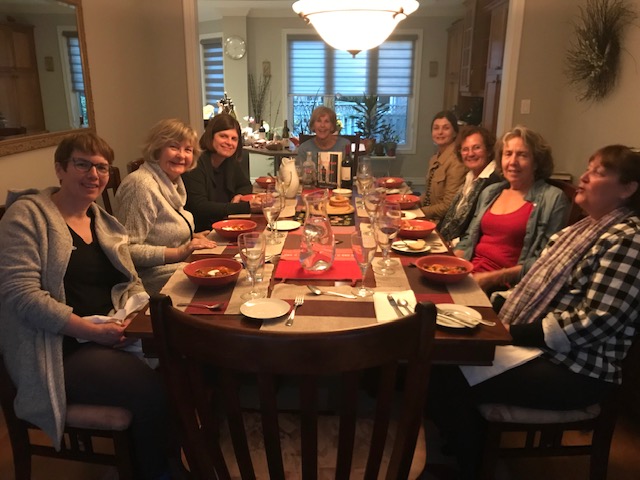
‘A Wife’s Tale’ by Aida Edemariam at Erin’s

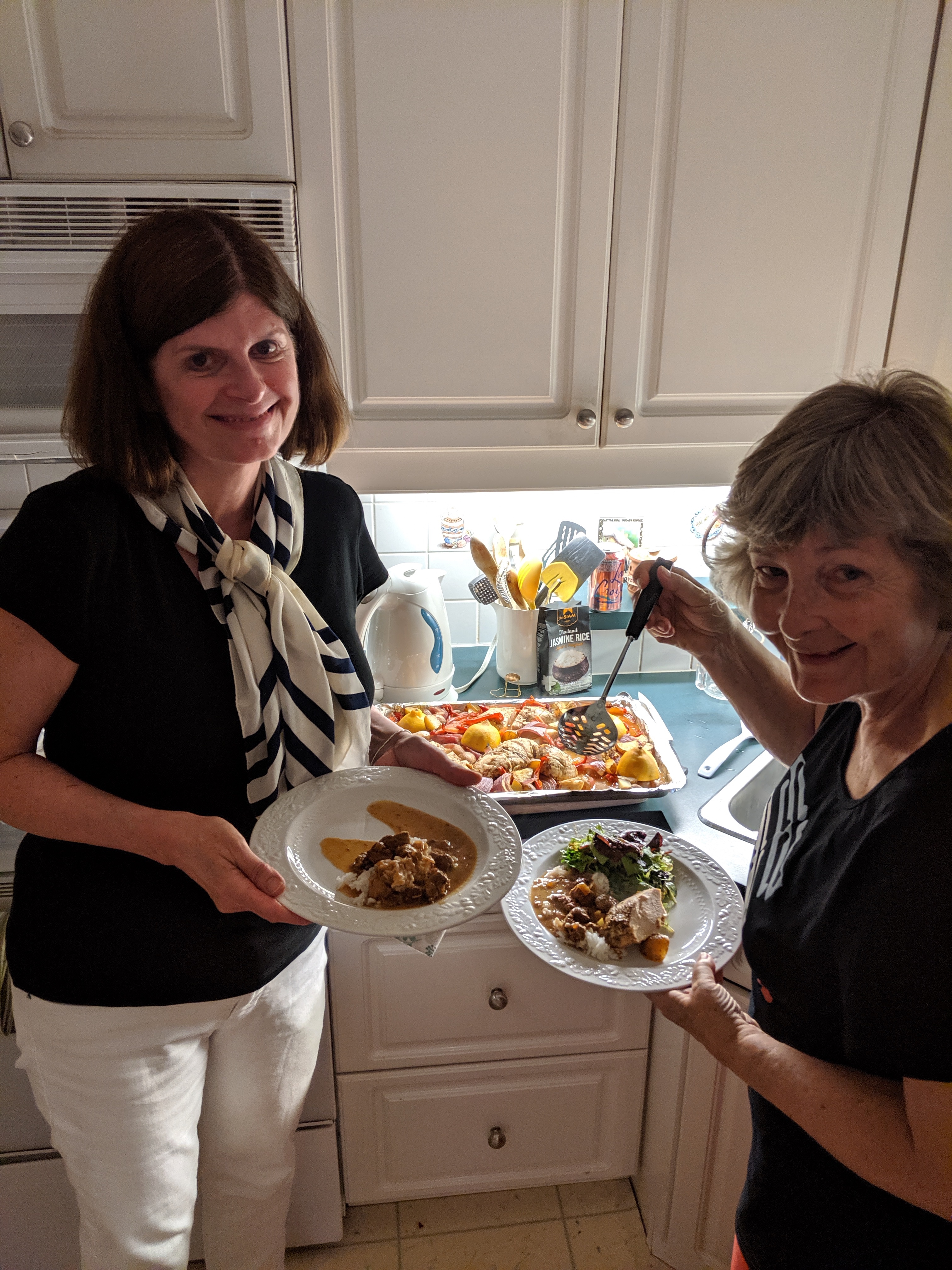
Wonderful evening at Erin’s – the consensus was that it was a challenging read and the evening was highlighted by a delicious (and time consuming) authentic Ethiopian meal prepared by Erin.

We also agreed, that as so often happens, we enjoyed the book more after the discussion.

From Karen:

Thanks Erin for putting a great deal of effort in recreating the unique and delicious Ethiopian cuisine mentioned in A Wife’s Tale.  It was well worth the trouble and was a hit with the group as evidenced by all the second helpings.  By the way, should anyone be curious, it seems we have a good Ethiopian restaurant in Hamilton (https://www.wassethiopianrestaurant.com/).  After trying last night’s meal, I am keen to give the restaurant a visit.  Please provide the links to your recipes on our blog.

I found “A Wife’s Tale” a difficult read and would have preferred to have the glossary expanded and moved (along with the timeline) to the front of the book.  That said, Yetemegnu’s life was inspiring.  Imagine a little girl, married at 8, unable to read, living a cloistered life with a husband who was 22 years older and forced to cope mostly alone, with Ethiopia’s turbulent political upheavals.  And yet she lived to see her grandchildren become educated professionals residing in different countries throughout the world!

From Bev: Karen raised some good points but may I add that reading a woman’s story set in another time and culture makes me thankful for the rights and freedoms I have in Canada. It also reminds me that women are always vulnerable and in times of adversity need to draw on their inner strengths to survive and in this case provide a better life for their children.

Leave a comment

Filed under Book Club Meetings

“I Feel Bad about my Neck” by Nora Ephron at Laura’s

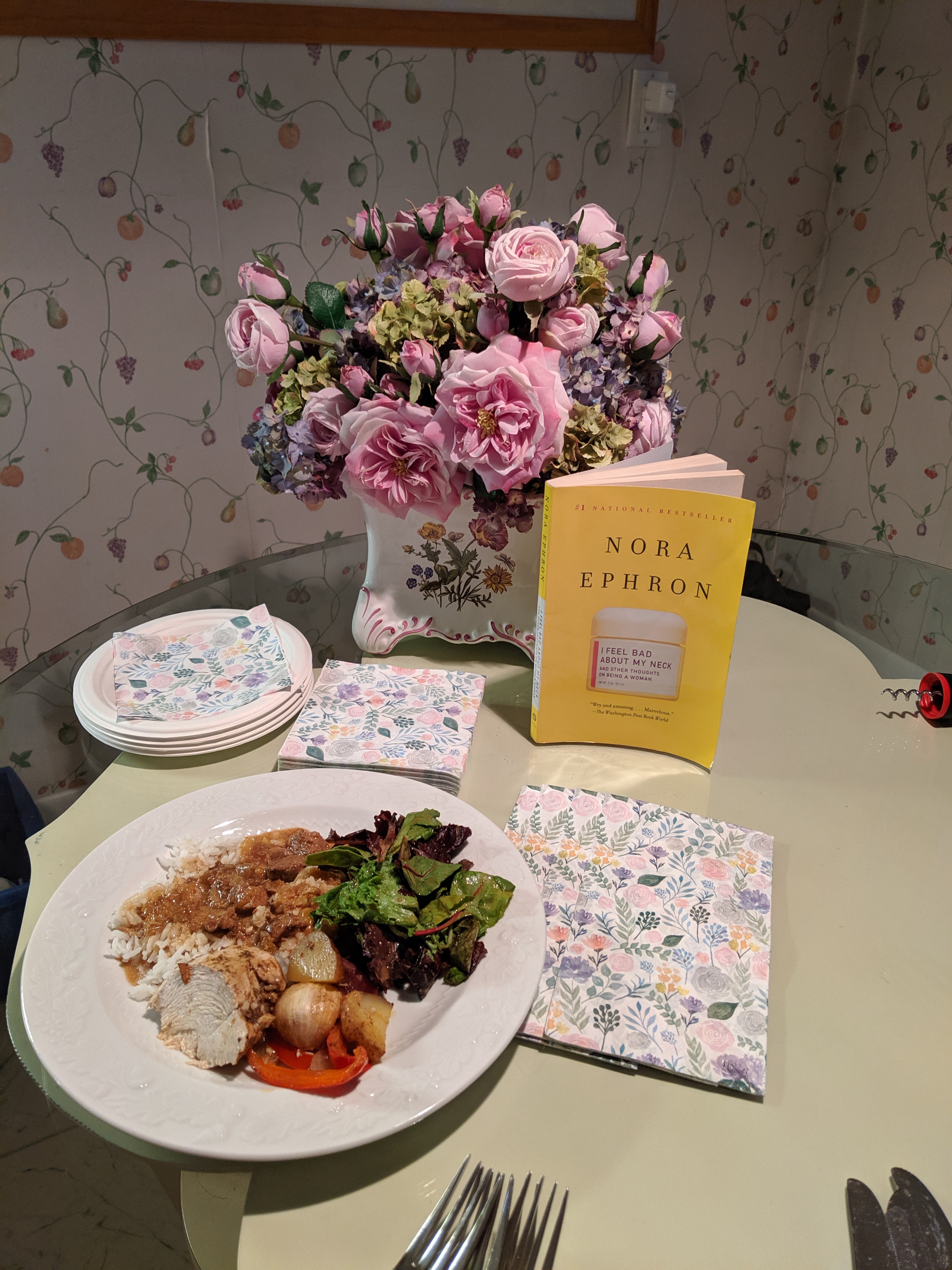
Reading Nora Ephron’s “I feel Bad about my Neck” was the perfect summer read – I read it sitting on my porch on a lovely summer afternoon – laughing out loud, shaking my head and thinking about how lucky I was to be in that exact spot at that exact time.

Like Nora, Laura was a thoughtful host and prepared a wonderful meal using Nora’s recipes and we were all encouraged to wear a scarf and come prepared to play one of Nora’s “parlour” games:

“We have a game we play when we’re waiting for tables in restaurants, where you have to write the five things that describe yourself on a piece of paper. When I was [in my twenties], I would have put: ambitious, Wellesley graduate, daughter, Democrat, single. Ten years later not one of those five things turned up on my list. I was: journalist, feminist, New Yorker, divorced, funny. Today not one of those five things turns up in my list: writer, director, mother, sister, happy.”

From Karen:

A wonderful evening Laura – a definite highlight of my summer.  The meal was DELICIOUS and offering us a glass of good French champagne was such a treat.  Champagne is synonymous with celebration. And anytime we get together is cause for celebration!  (I wish my retirement budget allowed me to bring a bottle to every one of our gatherings).  Thanks also for giving us a well-researched and interesting lecture on Nora’s life.  I think the only thing missing from last night was Nora herself.  She would have enjoyed our conversation and would have fit right in.

From Jill:

Many thanks Laura, a truly enjoyable evening of great conversation, game fun, and a delicious meal! Recipes please! I love champagne!
As I lay awake last night, ( it seems to occur more as one ages..I hesitate to say in our old age:), and mulling over our conversations of how our lives unfolded and how we dealt with our circumstances, the word inspired came to me. When I think back over the years, I realize how many people have inspired me, helped me to think, to become and be a better person.
The other word is motherhood. As a woman, it was the greatest miracle and brought me such joy to bring a little human being into the world.
Thank you again Laura for choosing this book, and to Nora Ephron for writing it, and to give us much food for thought that enables us to give voice to our own vulnerability, awareness and destiny.

From Moira:

wonderful evening spent in the company of wonderful women- who could ask for more?! Many thanks Laura, for choosing the book and giving us such insight into Nora the person, wife, mother, screenwriter …. extraordinaire. Loved BOTH  the meals, and the scrumpdilyicious key lime pie. Please put up the recipes- I might actually attempt one of them, haha. 

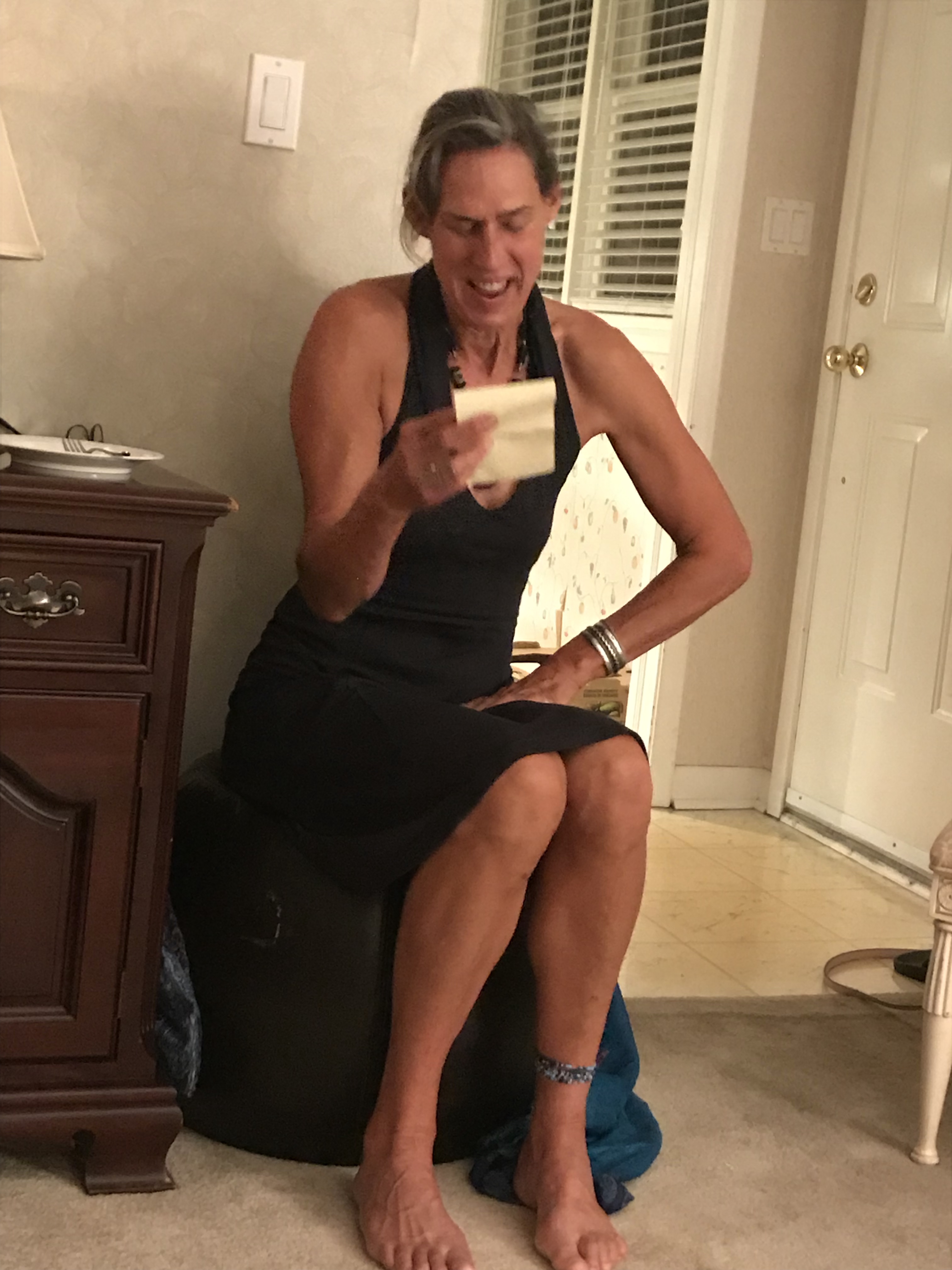
PS I love the picture of Josee – reading her list 🙂

Leave a comment

Filed under Book Club Meetings

‘Born a Crime’ by Trevor Noah at Jeanne’s

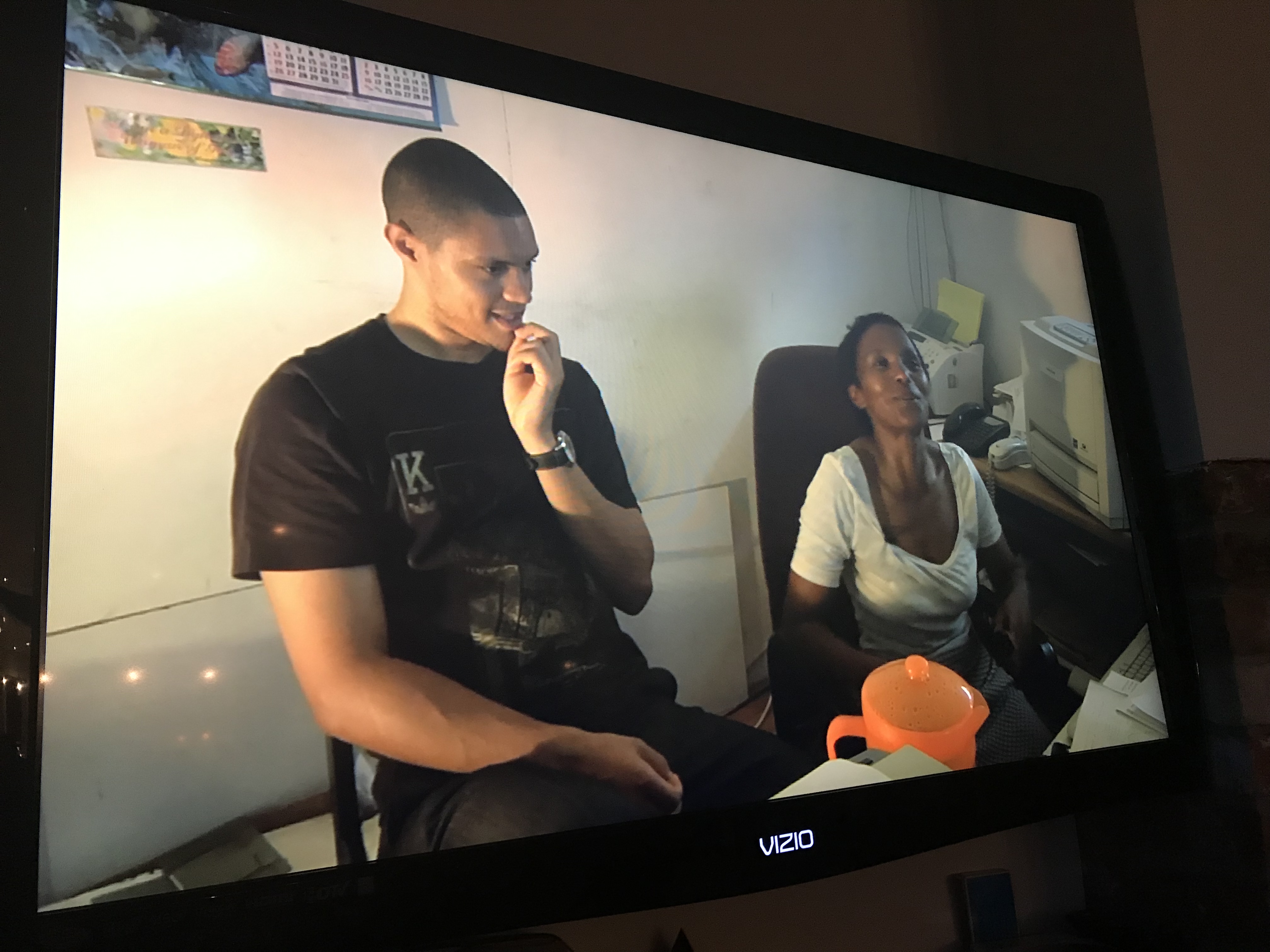
A foggy night up on the escarpment – A very evocative  setting at Jeanne’s discussing Trevor Noah’s funny and tragic story of his life growing up in South Africa.  Everyone enjoyed the book and seeing his remarkable mother and grandmother interviews.

Thank you Jeanne for the authentic and delicious South African food including bobotie and the extra bonus of going home with heirloom tomato plants.

From Jill: Jeanne, many thanks. A true authentic African Bobotie  dish…and all the other delicious dishes! 
I so admire how Trevor Noah overcame all odds with his background, to become the interesting, caring  and humorous person he is today. 
A great utube showing of his ‘chat’ with his grandmother, what a strong and self possessed woman. She, and those of her generation are to be admired. I enjoyed our interesting discussion. 
Thank you also for the tomato plant. I’m looking forward to sweet tomatoes!

From Bev: A wonderful evening Jeanne. Great food, thoughtful preparation for discussing the book, and as always good conversation. 

From Erin: Agreed!  A delicious evening all round! I loved the opportunity to meet Trevor Noah’s mother and grandmother… true forces to be reckoned with!  And… I look forward to the tomatoes from your seedlings Jeanne.

Leave a comment

Filed under Book Club Meetings

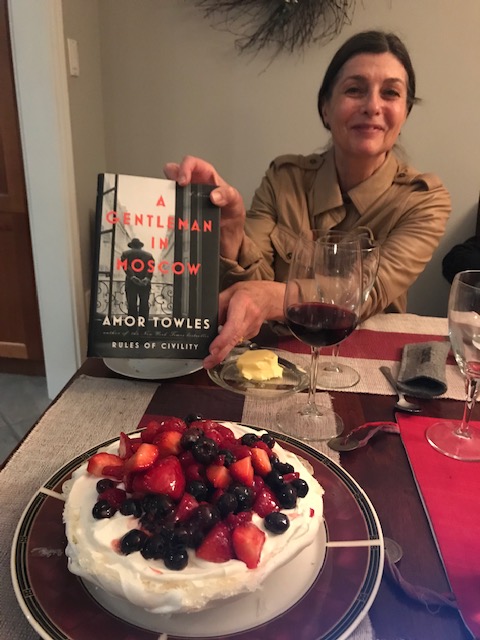
A Gentleman in Moscow by Amor Towles at Moira’s May 2019

Thank you Moira! I so enjoyed the absorbing information you shared about the background of Russian history and how it coincided with A Gentleman In Moscow. A truly fascinating story. 
Just out of interest, I was just googling the website and found the Book Food Club, and the recipe for the delicious Latvian stew. 
Wouldn’t it be cool if the Book Club Cookbook would offer recipes for all our chosen books:)
I also read that Kenneth Branagh is set to star and produce a tv adaption of A Gentleman in Moscow. That should be well worth watching. 
I’m so glad you had extra borscht over as I’m going to really enjoy it for my lunch! 
It’s always so special to get together with you all. Jill

Thanks Moira for taking the time to present us with a sample meal from the Hotel Metropol. It was a delicious dinner that will be a highlight on our book club blog.  I will definitely try to make both the soup and the stew next fall.  Yummy comfort food.A Gentleman in Moscow was a charming story and one I wouldn’t have expected given it takes place in a very turbulent time in Russia’s history.   It is quite the contrast to The Noise of Time by Julian Barnes which we read last year at Bev’s. By the way, I found this video tour of the Hotel Metropol on YouTube.  You might be interested to see the grand hotel now that it has been restored.  Karen https://www.youtube.com/watch?v=GFHVzUoBMH4

The author talks about his choice for the Latvian Stew
https://www.bookclubcookbook.com/gentleman-moscow-latvian-stew-recipe-author-amor-towles/

Leave a comment

Filed under Book Club Meetings

Becoming by Michelle Obama at Erin’s March 2019

It was a great evening. Michelle is to me the epitome of grace, intelligence and fortitude. Truly a model for all women. Several years ago I watched a documentary-movie called Southside which tells the story of her early years until she meets Barack. Nice watch and available from the library. Bev

From Karen: This is the excerpt I was referring to last night when Michelle spoke of leaving the White House.  I found this in an interview with Oprah Winfrey:

“But one of the show’s most memorable moments happened while the former First Lady opened up about how she prepared to exit the White House in early 2017. Specifically, she told Oprah that she burst into tears after leaving Washington, D.C. following President Donald Trump’s Inauguration. “When I got on the plane, I sobbed for 30 minutes,” Mrs. Obama said, according to the Associated Press. “I think it was just the release of eight years trying to do everything perfectly.” “I said to Barack, ‘That was so hard, what we just did. That was so hard.’”

From Laura, re above passage: Some written passages are so powerful. This one calls up perfectly the pressure cooker they must have existed in, and in one moment helps us to be in her shoes – the absolute care taken over 8 years to ensure they left an indelible impression on all of America, that black culture is still rooted in the values of honesty, dignity, integrity, and respect for family, ancestors, and community leaders – so missing in the current zeitgeist. It must have been hard!

Thanks Erin, it was a lovely evening, lovely dinner and great discussion!!

Let’s be very clear: Strong men – men who are truly role models – don’t need to put down women to make themselves feel powerful. People who are truly strong lift others up. People who are truly powerful bring others together. Michelle Obama

You may not always have a comfortable life and you will not always be able to solve all of the world’s problems at once but don’t ever underestimate the importance you can have because history has shown us that courage can be contagious and hope can take on a life of its own. Michelle Obama

Leave a comment

Filed under Book Club Meetings

The Childhood of Jesus by J.M. Coetzee at Jill’s January 2019

hFrom Erin: Thank you Jill for another lovely book club gathering… I think we all agreed JM Coetzee is a philosopher who communicates complex  dilemmas / questions via seemingly uncomplicated prose and plot.   It was interesting to discuss what he was trying to represent by the various characters and situations, but surely we agreed he has a ‘mother’ quest theme….

Follow up from Jill: I had no idea when I first read the book and suggested it for our bookclub, then researching the facts, how in depth the philosophies, the allegories, opinions, political and otherwise were! I found it all quite overwhelming but fascinating. I needed to hear all your opinions to help me sort out my own confusion. 
One question you asked Laura. Why was the story of Don Quixote chosen? We didn’t discuss that, and I had the same question in my mind through the story but didn’t research it. 
Here is a part answer of sorts. Coetzee invites us to consider philosophies of fiction. Why is Spanish the language spoken in his invented world? Because it is the language of Don Quixote, the Ur-novel, one of the first to pose the question of what realism is and what fiction is for. Which is more “real” more useful in navigating our existence: Quixote’s reckless romancing or Sancho Panza’s stolid pragmatism?In the Childhood of Jesus it becomes the springboard for an exchange between David and Simon about the nature of fiction. ” You can move your lips and make up stories in your head, but that is not reading” warns Simon. 
I had another question we didn’t discuss, I should have checked my notes better. David’s imagination about the barbed wire surrounding the Punta Arena special school that it was recommended he attend. As we read there was none, according to the teacher from the school. Was it to just get the attention of his ‘parents’ so he wouldn’t need to go, or, was he being just a willful naughty boy just to see what their reaction would be, or, was there in the depths of his mind a feeling of entrapment and injustice from the safe world Inez had suffocatingly cloistered him in? 
I know, I must put this book to rest! How I’d love to meet the author to hear his views. Apparently he’s a very quiet and solitary man who doesn’t deal well with public appearances, and usually tries to avoid interviews. 


Coetzee won the Nobel prize for literature in 2003, at the age of 63. 
He was given the prestigious award for his ability to write stories that in innumerable guises portray the surprising involvement of the outsider. 

Quote: “The absence of consistent logic forces one into all kinds of contemplation on serious issues”. 

Since The Childhood of Jesus is still fresh in my mind, I am curious to read The Schooldays of Jesus to see how the life of this unruly but interesting child continues, and whether Simon and Inez still play a major part in his life. There is something about the writings of this author that plays on my mind:)

From the Penguin Random House:
https://www.penguinrandomhouse.com/books/313480/the-childhood-of-jesus-by-j-m-coetzee/9780143125761/readers-guide/

In The Childhood of Jesus, Nobel Laureate and two-time Booker Prize–winning J. M. Coetzee returns to the allegorical style of his acclaimed 1980 novel, Waiting for the Barbarians. A middle-aged man named Simón and a six-year-old boy named David arrive at the town of Novilla in an unspecified, Spanish-speaking country. They have come from a camp, by boat, and appear to be refugees, though from what is unclear. Strangers in a strange land, they hope to start a new life in Novilla and to find David’s mother.

Simón arrives with one unshakable conviction: that he will know the boy’s mother when he sees her—a conviction based entirely on intuition. He has never seen David’s mother, has no photographs of her, does not know her name or anything about her. Nevertheless, he has no doubts that he will recognize her.

Shortly after arriving in Novilla, Simón takes a grueling job as a stevedore, unloading the sacks of grain that will be used to make the bread on which the town relies, almost exclusively, for its nourishment—as if to refute Jesus’ assertion that man cannot live by bread alone. Indeed, Simón finds the blandness of life in Novilla exasperating. He engages in one argument after another: with his boss and fellow stevedores; with Elena, the mother of David’s friend Fidel; and virtually everyone else he meets in Novilla. His suggestion that the dock workers use a crane to liberate themselves from brute labor and allow them to do more meaningful work is met with bafflement, just as his need for sex and what Elena calls “the something-more that is missing” is dismissed as a hopeless illusion, impossible to satisfy and foolish to pursue.

While out for a walk, Simón and David encounter a woman playing tennis and Simón instantly “knows” her to be David’s mother. Though she has never seen David, Inés reluctantly agrees to take over the care of the child. Absurdity slides into reality, as Inés fully assumes the role of mother, becoming as fiercely overprotective as if she had borne and raised the child herself.

Then there is the question of David’s education, both formal and informal. At home, Simón tries to answer David’s many dogged existential questions: How are people different from “poo”? What are dead bodies? What is value? At school, David infuriates his teacher, Señor Leon, with various acts of “insubordination”: refusing (or pretending not to know how) to read or count, and disturbing his classmates. The school psychologist wants to separate David from his “parents” and place him in a special school, far from home, a plan which Inés and Simón vehemently oppose.

Novilla—the word contains echoes of villavillage, and novel—is a strange and unsettling place, or rather a no-place, a stripped-down stage set on which the characters carry out their Beckett-like philosophical debates. The inhabitants have been “washed clean” of their former lives as well as all desire for something more. They are content with things as they are, no questions asked. They are, as Simón notes, a passionless people, incapable of either irony or strong emotion. “No one swears or gets angry. No one gets drunk. No one even raises his voice” (p. 30). They do not suffer from the need for meaning, purpose, sexual and spiritual fulfillment that afflicts Simón. But have they transcended such desires or merely accepted a diminished version of full human potential?

Much in The Childhood of Jesus remains ambiguous, including the title itself. Is David a Christ figure? His “mother,” Inés, is a virgin. When his teacher tells him to write “I must tell the truth” on the blackboard, he writes “I am the truth” instead. Biblical references abound, but don’t seem to point to a coherent allegorical design. Or do they?

Coetzee’s magical and austere novel invites readers to investigate the many existential questions raised within its pages, as well as the larger question of the purpose and meaning of the novel itself.
ABOUT J. M. COETZEE

J. M. Coetzeewon the Nobel Prize for Literature in 2003 and is the author of twenty-one books, which have been translated into many languages. He was the first author to twice win the Booker Prize. A native of South Africa, he now lives in Adelaide, Australia.

Potato Chili. Serves 8. 
( I doubled up on the onions, garlic, carrots and celery) 
I cup dried green or brown lentils. I used both. 
1 19 oz can kidney beans.
1 19 oz can chickpeas.
1 19 oz can chopped tomatoes with juice.
2 cups tomato sauce.
2 cups vegetable stock. 
3 potatoes diced. 
I large onion chopped.
2 carrots chopped. 
I celery stalk chopped.
I red or green pepper chopped. 
2 garlic cloves, crushed.
2 tablespoons Chili powder 
1 teaspoon dried oregano 
1/2 teaspoon dried basil. 
1/8 teaspoon freshly ground pepper. 
1/2 cup plain yogurt, optional. 

Leave a comment

Filed under Book Club Meetings

Do Not Say We Have Nothing by Madeleine Thien at Bev’s December 2018

Wow, an evening of amazing food and a really great discussion of China and its people, politics and cultures! Jane and Moira shared reflections and experiences from their recent visits to China. The book was fascinating and eye opening for events that happened in our lifetime in China from a family’s perspective.

From Jane: Thank you Bev – it was a really wonderful night – you really helped my brain better understand the book. It was surreal for me to be reading the book while in China. 
Here is a description of the social points that we were discussing:https://en.m.wikipedia.org/wiki/Social_Credit_System

From Laura: Thank you Bev for all of your hard work, those dishes were so tasty! You make it look effortless, but I know a lot of chopping and coordination was going on leading up to our arrival. Great questions about the story from everyone, and so timely to contrast China’s murky history with their growing influence in the world today. It’s difficult to sort out all of the complexities of China when they work so diligently to smooth it all over.  

From Bev: I’ve added this news report to add to Jane’s earlier item. Seldom do we get a glimpse into the powerful people involved in the rise of the Chinese economic phenomenon. Although Meng has been arrested in Vancouver, the fraud has to do with US sanctions on Iran and demonstrates the US and China rivalry for world technological dominance. 

Woman arrested in Vancouver helped turn Huawei into household name in China.
https://www.thestar.com/business/2018/12/06/woman-arrested-in-vancouver-helped-turn-huawei-into-household-name-in-china.htm

Recipes:

Spiced Cashew Shrimp
11/2 pounds medium shrimp peeled and deveined
Kosher salt and freshly ground pepper
1 Tablespoon cornstarch
2 Tablespoons oyster sauce
2 Tablespoons safflower oil
4 celery stocks, cut on bias 1/4 inch thick (21/2 cups) plus celery leaves for serving
1 teaspoon finely grated garlic (from 2 cloves)
1 tablespoon finely grated ginger (from 2 inch piece)
Pinch of red-pepper flakes, plus more for serving
1/2 cup roasted cashews
Steamed white rice
Pat shrimp dry with paper towels; toss with 1/2 tsp salt and 1/4 tsp pepper. In a small bowl,
whisk together cornstarch, oyster sauce and 3/4 cup water.
Heat large skillet over high heat. Swirl in oil, then add shrimp in a single layer; cook undisturbed
for 1 minute.
Continue to cook, stirring occasionally, until almost cooked through, 1 to 2 minutes, add celery,
ginger and red pepper flakes; cook stirring, 1 minute.
Add cornstarch mixture; stir until sauce thickens and coats shrimp and vegetables.
Serve over rice. Sprinkle with cashews, red pepper flakes and additional celery leaves.
Total time: 20 minutes serves 4

Lemon Chicken with Green Beans
14/4 pounds boneless chicken breasts cut into small pieces
Kosher salt and freshly ground black pepper
1/3 cup corn starch
11/2 cups low sodium chicken broth
2 teaspoons grated lemon breasts, plus 3 tablespoons fresh juice
1 tablespoon sugar
1 tablespoon sesame oil
1 tablespoon minced garlic (from a 1 inch piece)1/2 cup safflower oil
12 ounces green beans trimmed and halved on bias
Steamed white rice
Pat chicken dry and season with 1 teaspoon salt and 1/2 teaspoon pepper; toss with cornstarch.
Combine lemon zest and juice, sesame oil, ginger and 1 teaspoon salt. Stir in sugar until it
dissolves.
In a large skillet, over medium high, heat 1/4 cup safflower oil until shimmering. Add beans and
cook, stirring occasionally, until they blister in places, 3 minutes. Transfer to a paper towel.
Sprinkle with salt.

Add 1/4 cup safflower oil to skillet; heat 1 minute. Add chicken; cook, stirring once, 4 minutes.
Transfer to paper towels; discard oil. Add broth mixture, scraping up browned bits with spatula,
1 minute. Return chicken to pot (check to see that you do not have too much broth mixture).
Simmer until sauce thickens and coats chicken, 2 to 3 minutes. Serve over rice. Top with
blistered beans.
Prep time :35 mins. Total time: 45 min. Serves: 4

Broken Wonton Soup
1 teaspoon safflower
1 tablespoon thinly sliced garlic. (2cloves)
1 heaping tablespoon ginger match sticks (thinly sliced from 1 inch piece)
4 cups chicken broth
2 tablespoons chopped cilantro leaves (screams reserved)
2 tablespoons soy sauce
12 ounces uncooked breakfast sausage, casings removed
12 ounces bok choy ( 2 medium or 3 small) roughly chopped
12 wonton wrappers, quartered and chopped diagonally
Chilli garlic sauce for serving
Heat oil in a medium sauce pan over medium-high heat; add garlic and ginger and cook until
fragrant, 30 seconds. Add broth, 2 cups water, cilantro stems, and 1 tablespoon soy sauce.
Bring to a boil, then reduce heat to low and simmer, partially covered for 20 minutes. Remove
and discard cilantro.
Meanwhile in a medium bowl, combine sausage, remaining 1 tablespoon on soy sauce and
cilantro leaves. Roll mixture into 1 inch meat balls.
Return broth mixture to a simmer; stir in meat balls. Cover and let stand until meatballs are
cooked through, 5 to 6 minutes. * Add bok choy. Drop in wonton wrappers into soup, one at at
time and stir to prevent sticking.
Divide amount 4 – 6 bowls.
Prep: 35 minutes total time: 55 min serves 4-6
*I changed the recipe slightly. I found in the original the bok choy was over cooked. I like bok
choy al dente.
Wonton noodles are basically the same as lasagna noodles only thinner. Several good sites on
the internet with recipes.
This soup would also be good with ready made wontons rather than the sausage.

Leave a comment

Filed under Book Club Meetings

Educated by Tara Westover at Jeanne’s November 2018


Thursday November 8th, everyone was there except Bev for the discussion on Educated by Tara Westover. This was a last minute book change from the scheduled book “Born a Crime” by Trevor Noah. As always there was animated discussion and we were not shy about expressing our opinions. We all agreed that we are blessed to have grown up in a free country with a great education and opportunities for work, travel, and much more!!

Link from Laura:

I happened to listen to the latest This American Life podcast last night and one of the segments in the episode dealt with a Mormon practice I had not known of prior to this, concerning “chastity rules”. I wondered whether Tara Westover had submitted to this practice during her early adolescence, and if so, she overlooked mentioning it in her book but it definitely would have contributed to her being “Educated”. She would have had to have her Bishop’s signoff in order to get into BYU. I include the link below if you want to listen to it – segment 1 – The Old Man on My Shoulder.


New book reference from Moira:

Who doesn’t love a story about a woman overcoming incredible odds, not to mention  the power of education in elevating the poor. I read The Hillbilly Elegy a couple of years ago which was a similarly illuminating novel about a group known as “white trash” who are both unable and unwilling to change and who live where education seems inaccessible/unattainable – hard to believe in this day and age.

From Jeanne’s notes:

Summary and Interview with Tara Westover

Tara Westover was born in Idaho in 1986. Her father, Val, and mother, LaRee, raised five sons and two daughters (Tara is the youngest). Val, who is given the pseudonym “Gene” in the book, is a fundamentalist Mormon who has devoted his life to preparing for the End of Days. His paranoia took a turn for the worse in 1992 after the tragic and highly publicized incident at Ruby Ridge, Idaho.

At the center of that affair was a Christian fundamentalist named Randy Weaver, a U.S. Army veteran who had served in Vietnam, before settling with his wife and children at a remote farm in Idaho, in the American northwest. Like the Westover family, the Weavers believed in the imminent apocalypse, and tried to live independently of the authorities and be fully self-sustained.

During the 1980s, Randy Weaver attended rallies organized by extreme rightist organizations, among them such neo-Nazi groups as the Aryan Nations. In August 1992, the FBI raided Weaver’s home in search of illegal weapons. The raid went awry and FBI agents shot and killed Weaver’s wife Vicky and their 14-year-old son.

For Val Westover, the Ruby Ridge raid, which elicited harsh criticism of the government and the FBI, was a turning point. According to Tara, her father was convinced that his family was next in line. He believed with all his heart that the FBI intended to abduct his children, for the purpose of entering them in the public school system to “brainwash them.” Hence his decision to school them himself.

The education they received was based on a mix of racist beliefs and conspiracy theories. Val categorized the women in his world as either “saints” or “whores.” Westover relates in her book how her father and her brothers called her a “whore” when she rolled up the long sleeves of her blouse when working at the junkyard on a broiling summer’s day. Years later, when she registered for an introductory psychology course, she encountered the term “bipolar disorder” for the first time and realized to her astonishment that her father suffered from all the symptoms the lecturer described so drily, including paranoia and attacks of rage. She says that now she believes that all his life her father has suffered all from an undiagnosed psychiatric disorder.

“My dad was extreme about all of his views,” she tells me. “His mental irregularity was probably caused his religious extremism, and not the other way around. Everyone in my town was Mormon, and they went to the doctor and sent their kids to school.”

Indeed, the memories Westover describes in “Educated” are so shocking that it is easy to understand why her parents have done everything possible to refute them. Her childhood is described in an ambivalent way: On the one hand, she experienced the first years of her life as an attempt to survive in surroundings that were isolated and full of challenges (including preserving fruit and vegetables, and stockpiling equipment for an emergency that would help the family survive after the apocalypse). On the other hand, even today she emphasizes that in her childhood she was surrounded by family, wild nature and animals, and even today she stresses that her environment was fascinating and loving. She knew by heart every path and tree on the mountain that cast its shadow on the house, and before she reached the age of 10, she knew how to tame wild horses, dismantle a used car and prepare natural tinctures.

The idyll, however, crumbled quickly during her adolescence. Luke’s accident wasn’t the last one involving the children of the family, and that the parents tried to conceal from the authorities. The entire family was involved in a bad road accident but her father chose not to call the police because, not trusting insurance companies, he had never taken out insurance for himself, his children, or his car.

A few years later, another of the brothers, referred to by the pseudonym “Shawn” in the book, fell from a great height after losing his balance while trying dismantling some scrap metal. He suffered a concussion, but his father and his other siblings refused to call for medical assistance. The father just told him to take a break and come back to work.

About a quarter of an hour later, after Shawn had recovered a bit from the fall, he returned to the junkyard and started quarreling with his father and shouting at him. After he tried to shove his father, the two other brothers present attacked Shawn and beat him. He received another serious blow to his skull and lost consciousness.

In the book, Tara relates that eventually someone – though it is not clear who – decided to call for an ambulance. This was the first time in the family’s history that someone gave in to common sense and chose to ask for help. Since Shawn’s condition was grave and he was unconscious, the hospital closest to their home sent a rescue helicopter, a decision that probably saved his life.

According to Tara, Shawn was never the same after the injury. He became an aggressive, impatient and fanatical young man. His fits of violence became a heavy shadow over the lives of Tara and her sister. Ultimately, her parents’ choice to side with Shawn and completely deny his violent behavior is what made Tara feel she had to choose between them and her own sanity. This choice took up many years of her life, and even now, it seems like she has not yet come to terms with the severance of relations that was forced upon her. “Once I confronted them about Shawn, my parents tried to convince me that I was insane, and that my memories could not be trusted,” she tells me. “It was an attempt to control me.”

However, even this narrative is not as entirely unambiguous as it might seem. As Tara writes in “Educated,” at the age of 16 she wanted with all her heart to believe that it was the accident that caused her brother to become a monster capable of abusing her physically and mentally. The abuse continued throughout most of her adolescence: Shawn would curse his younger sister, hit her and shove her head into the toilet. In two separate incidents, he broke her wrist and her toe when she tried to resist.

But she has even earlier memories of abuse at the hands of Shawn, memories that call into question the relatively comforting belief that it was the head injury that caused his outbursts of violence. There is comfort in cause and effect, she writes, especially with regard to a continuing tragedy that is almost impossible to translate into words.

“When you love someone, you want to absolve them of responsibility for the bad things they have done,” she says. “It took me a long time to realize that you could do that if it makes you feel better, but that doesn’t change the decision you will have to make. So, with my dad, I feel like working with him in the junkyard was dangerous, and whether he was responsible for that doesn’t matter. If it turns out this is the result of bipolar disorder, it might make it easier for me – but it doesn’t change the fact that I wasn’t safe there.

“The question is not whether Shawn or my dad are malicious or evil. The question is what might have happened to me if I had stayed in these relationships. I think that there is a phase of bargaining that you go through when you’re trying to extract yourself from a toxic relationship, and a lot of that is going to be focused on the other person: whether they deserve having you leave them and so on. But a later, healthier, stage is to ask not whether they deserve it but whether I deserve it. If not – you need to get out whether they are responsible for it or mentally ill.”

Did you ever consider filing a police report against Shawn?

(Laughing bitterly:) “I grew up thinking the police were a part of the Illuminati. Calling them was never an option.”

After you told your parents about the abuse, Shawn threatened to murder you and placed a bloodied knife in your hand. He had access to guns, and he had butchered his dog and beaten his wife.

“I remember the night that he threw his wife out of the house,” says Westover, referring to an event that occurred when she was 18. “I remember vaguely thinking that it would be a good idea to call the police so she could have a record for her protection, in case she would want to leave him. But I didn’t want to question my dad’s decision.

“The funny thing is that every time I went back home, I returned to being their daughter. So something that might seem abnormal in any other context suddenly seemed normal again. I was back in a world where the police was never an option.”

Westover’s story raises difficult questions about the role of the authorities – which never bothered to probe why her parents took out a birth certificate for her only when she was 9 years old, never vaccinated her and insisted on schooling her at home. At the same time her story is an impressive and convincing defense brief for the higher-education system. Precisely at a time when anti-intellectualism has become a disturbing trend in America, Westover tells a Cinderella story of a lost girl who becomes a self-confident young woman thanks to her exposure to history, literature, philosophy and art.

She says the sole reason she was able to attend college was the help of her brother Tyler, who had taught himself mathematics and taken the college entrance exams secretly. After Tyler left home to study for his bachelor’s degree, he left his sister textbooks and encouraged her to take the standardized exams in mathematics, reading comprehension and written expression. Westover knew that her father would oppose this and therefore she had to study in secret at night, after exhausting days of working at the junkyard and in her mother’s improvised laboratory (“God’s pharmacy,” as her father called the family kitchen). Ultimately, she took the exams, received excellent scores and paid for her first year at Brigham Young by working the night shift in a grocery store in a nearby town.

The fact that she had never encountered the word “holocaust” wasn’t the only evidence of her unusual background. She had never heard of Napoleon, Martin Luther King or the civil rights movement. She had a hard time understanding an introductory history course until a friend explained to her that Europe is the name of a continent and not a country.

The more introductory courses and seminars she took, the more Westover realized that her father’s view of the world was extreme, distorted and very partial. When her parents came to visit her at college – for the first and last time – she took them to an Indian restaurant.

“We waited for the food, and Dad asked about my classes,” she writes in “Educated.” “I said I was studying French. ‘That’s a socialist language,’ he said, then he lectured for 20 minutes on 20th-century history. He said Jewish bankers in Europe had signed secret agreements to start World War II, and that they had colluded with Jews in America to pay for it. They had engineered the Holocaust, he said, because they would benefit financially from worldwide disorder. They had sent their own people to the gas chambers for money.”

When I ask Westover why she didn’t try to argue with her father even though she knew for certain that he was mistaken, she replies that she realized full well that she didn’t stand a chance of changing his mind.

“I’ve never tried to educate him, because it would just lead to a much longer lecture. There was one conversation I remember having with my dad, when he talked about the Founding Fathers, and said it [that is, the early years of the United States] was the most moral epoch in the history of mankind, and if only we could go back to that, everything would be so much better. I remember saying to him, ‘You mean, when women couldn’t vote or own property and you could legally rape a woman if she was black? Is that really our Golden Age?’ And that was the only time in which he kept quiet and thought about what I had said. He wasn’t willing to defend that argument.”

In the book, you write that there were some things in the unusual education you had from your parents that you are grateful for.

“That’s right. My parents believed that it was your responsibility to learn, and that you could teach yourself whatever you put your mind to. When I did get access to an education, in college, the idea that it was someone’s else responsibility to teach me would never have occurred to me.”

No blacks, no Jews

The ongoing success of “Education” has made Westover a reluctant star. In the months since it was published, she has been running from one news studio to the next, telling CNN about her years at Cambridge and being photographed in a red dress and high heels for The Times of London. The release of the book, however, constituted a mortal blow to her relationships with Shawn and her parents. Today, she says, she is in touch with only three of her siblings.

Her parents declined a request to be interviewed by Haaretz. Their lawyer, Blake Atkin, however, denies many of Westover’s accusations and asserts that the education she received at home has enabled her and siblings to pursue higher education. (See his full statement, below.)

Beyond Westover’s talents for writing and storytelling, the success of “Education” can also be attributed to the American thirst to learn more about the lives of “the other America.” When asked if she thinks her book can provide new insights into America’s fundamentalist right, Westover hesitates and explains that her family is not a typical white family.

“I didn’t set out to write a political book. I wanted to humanize people who have radically different beliefs They are still full, complicated human beings. My dad has some crazy beliefs, including racist and anti-Semitic beliefs, but he is also a full, complicated human being.”

When you were growing up in Idaho did you ever meet someone who was either black or Jewish?

“No, no one,” she says with a smile. “I think I met my first African-American when I was a senior at BYU, at age 22. I only met Jews when I went to Cambridge at 25. But I probably never had a conversation with someone who was African-American till my mid-twenties. So for me racism was theoretical. And theoretical racism is really easy to hold on to. If there is no one there to contradict it, it is very easy to pass on these ideas.  

“I think sometimes people think that they have a right to be prejudiced and dehumanize other people if those people dehumanize a third party. But then we risk being incredibly prejudiced against racist people. It means that there are people we don’t want to engage with, and it’s okay to reduce their entire existence to a very simplified view. We wouldn’t reduce a black person to just one part of their identity. And I think it’s a hard case to make because it sounds like I’m defending them and I’m not. I don’t defend their beliefs. But I do say that if we’re serious about persuasion and enlightenment, that has to stop. It’s not productive for dialogue or any exchange of ideas.”

Who helped you change your way of thinking?

“It was a very long process. When I went to Cambridge, I was extremely homophobic. The only things I’d ever been told about gay people was that people become gay if they were molested as children, and that they will molest children when they grow up. This was my education on this topic. So if you asked me back then, ‘Should we allow gay couples to have children?’ my answer would be ‘absolutely not’.

“But when I got to Cambridge I had a really long conversation with someone who forced me to say out loud ideas that I had, that once I said them I felt very uncomfortable. The only reason I said them was that he never walked away or was appalled. He never said, ‘You’re a terrible human being.’ He just said things like, ‘There are no data that support that claim. Why do you believe that?’ I didn’t feel attacked or dehumanized. He was much more generous to me than I was to homosexuals, and that allowed me to change my mind. We argued till 3 A.M. and the next day I wrote him an email and said, ‘Thanks for talking with me last night. I decided that you’re right and I was wrong.” He was the first person who took the time to make the other case to me, over and over.”

You never managed to have a conversation like that with your father.

“No, but I do think that he is a moral person who always believed he was doing the right thing. Even though some of his ideas are hurtful and weird, they don’t come out of hatred or evil.”

Perhaps that in fact is the tragedy.

“It is a huge tragedy, but there is also a spark of hope. That way it’s

possible to think that maybe nevertheless there is away to talk with him.”

What would you tell someone who feels deeply estranged from their family?

“If you could base your reason and choices on yourself and not on them, it’s better. There were many years in which I tried to justify my decision not to see my parents any more, based on things they had done or how culpable I thought they were, constantly tallying up everything bad they had ever done and trying to convince myself that it was bad enough to justify my decision. No matter how angry I felt, I never had enough that I felt justified for doing that. It never felt okay to me. I think I started to feel better about it once I realized it is not about what they have done – but about what I deserve.

“Anger can be a good thing. It’s a mechanism that your brain uses to get you out of situations that are bad for you. But in terms of leading a peaceful life, it is not very productive. You will have to live with it every day. Using anger to justify this decision for 30 years is just going to make you really miserable. Self-respect and self-love is much, much better. I choose not to see my parents because I value myself – and they didn’t value me or my mind. Forgiveness isn’t necessarily the absence of anger; it’s also the presence of self-love. When you value yourself, you don’t have to be angry.”

We all want to believe that if only we could forgive ourselves and others, the road to reconciliation awaits. If it were a Hollywood movie, it would end with a tear-jerking reconciliation.

“It might not end with reconciliation. I can’t have my family in my life because they are abusive, and I don’t have control over that. There is an abusive culture in my family, and I have to turn away from it. So forgiveness and reconciliation is not the same thing. Once I accepted my decision on my own terms I could let go of what they have done to me. If you want to live a miserable life – making your life all about other people is the way to do it.”

Lawyer for parents: Tara’s education was better than one at a public school

Blake Atkin, a lawyer representing Tara Westover’s parents, replied by email to questions from Haaretz. He claims that “Educated” creates a distorted picture of Val and LaRee Westover.

According to Atkin, “We used to think that the purpose of education was to teach young people to think, not to just be able to regurgitate dates or facts that someone else has collated. Tara tells a cute story of being in a college class and not knowing what the professor was referring to when he spoke of the Holocaust, as if somehow that proves her education was lacking. An educated person reading her book might conclude that parents who prepared her well enough that she was accepted at a renowned university at age 16 – on an academic scholarship – ‘without ever having stepped foot in a classroom, just might conclude that her home-schooling really was an education, even if she did daydream through lessons on the Holocaust and other world tragedies, which her mother is adamant she was taught.  

“Like her older siblings, Tara always had the option to go to the public school. Some of her siblings went to public school. An educated reader might find it difficult to believe that her home-school education was deficient when she finally reveals near the end that she is not the only Ph.D. in the family. Of the seven children, three hold Ph.D.s. Show me any public school with those kind of results. Of the four without Ph.D.s, three, like their parents, left college when they determined it did not meet their needs. The four who do not hold Ph.D.s are happy, successful, well-balanced citizens of the communities in which they live. No alcoholics, no felons, no drug addicts, no chronically unemployed among them. An educated person would conclude that the Westover home school performed in a way we can only hope public schools could imitate.  

Asked why her parents did not protect her from an ongoing abuse by her brother “Shawn,” Atkin writes that, “The story Tara now tells is substantially different from what she was saying to her parents and what she recorded in her journal at the time. Her parents are most heartbroken over the tales she now relates and hope there can someday be a healing for Tara.

“Similarly, although Val and his children were often in harm’s way, due to the physically demanding nature of the work they were involved in, the stories of wanton carelessness in Tara’s book are all fabrication. And while the family was inclined to seek and use alternative medicine in instances of injury or sickness, they were not shy of using doctors for broken bones or other conditions for which traditional medicine provides the best answer.”  

Tara talks about her mother and sterotypes

Mother

Westover’s mother is one of the more complicated characters in the book, seeming to waiver between two life paths. She lives within her husband’s world but she wants Westover to go to college. She brings a forbidden phone line into the house. She eventually builds up a massively successful business with her natural remedies that supports most of the family and is still in operation today, “a spiritual alternative to Obamacare.” She once told Westover: “I should have protected you,” before turning on her entirely.

“She’s really talented, really competent, but she is really submissive and passive. She will always defer to my father,” Westover says.

Westover had some anger when she first attended university and struggled to keep up with her peers – but she does not resent her parents failure to educate her: “I don’t think they were being malicious or selfish.”

So what was it in that 16-year-old that made her drive forty miles for text books to get through those entrance exams? She credits her older brother Tyler, who also left for college, as a support and influence. They remain close. But also, she was beginning to recast her idea of what a woman should be.

https://www.haaretz.com/jewish/holocaust-remembrance-day/.premium.MAGAZINE-how-tara-westover-found-out-about-the-holocaust-and-became-educated-1.6221342

Stereotypes

She hopes however that the book is not used to affirm stereotypes. “They’re very religious and they’re very pro-gun rights,” she concedes. “If you end there, you have a caricature.” Her father and brother had views that came from ignorance, not malice. “I would hope to contribute constructively to the debate in terms of constructing people as full and complete human beings, and not just as caricatures of political views.”From The Irish Times.

Leave a comment

Filed under Book Club Meetings

Between the World and Me by Ta-Nehisi Coates at Laura’s September 2018

Delicious Soul Food Menu: Laura will send recipes to be added to this post

Laura’s background and timeline slides will be added to this post eventually

Ta-Nehisi Coates’ Between the World and Me Summary
This is a Summary of Ta-Nehisi Coates’ #1 NEW YORK TIMES BESTSELLER Between The World And Me Hailed by Toni Morrison as “required reading,” a bold and personal literary exploration of America’s racial history by “the single best writer on the subject of race in the United States” (The New York Observer) “This is your country, this is your world, this is your body, and you must find some way to live within the all of it.” In a profound work that pivots from the biggest questions about American history and ideals to the most intimate concerns of a father for his son, Ta-Nehisi Coates offers a powerful new framework for understanding our nation’s history and current crisis. Americans have built an empire on the idea of “race,” a falsehood that damages us all but falls most heavily on the bodies of black women and men-bodies exploited through slavery and segregation, and, today, threatened, locked up, and murdered out of all proportion. What is it like to inhabit a black body and find a way to live within it? And how can we all honestly reckon with this fraught history and free ourselves from its burden? Between the World and Me is Ta-Nehisi Coates’s attempt to answer these questions in a letter to his adolescent son. Coates shares with his son-and readers-the story of his awakening to the truth about his place in the world through a series of revelatory experiences, from Howard University to Civil War battlefields, from the South Side of Chicago to Paris, from his childhood home to the living rooms of mothers whose children’s lives were taken as American plunder. Beautifully woven from personal narrative, reimagined history, and fresh, emotionally charged reportage, Between the World and Me clearly illuminates the past, bracingly confronts our present, and offers a transcendent vision for a way forward.
The Meeting!!

As background for the book Laura gave us a well researched history of slavery, the progression of the cotton industry and the economy of the Confederate States which was built on the backs of slave workers and the political, social and economic powers that battled over the abolishment of the “slave trade” in the US. The time line Laura put together of the sequence American legislation and consequential action and inaction resulting from such legislation that was an eye opening look into all of the contradictions and inconsistencies caused by political and economical expediency which steamrollered over human rights and perpetuated the cruel, dehumanizing abuse and segregation of a race of people.

Laura, thank you! You have opened my eyes to another level of context and perspective for not just US history and the subjugation of one race of people but to further realization of the depths of power struggles and systemic abuse of groups of people based on race, religion, nationality and poverty perpetuated by the political maneuvering for economic wealth and domination ubiquitous around the world today.

Notes of appreciation!:

Karen: Thanks for taking the time to research the history of black enslavement in America.  Your work deserves a careful review when the slides are posted on the blog.  And thanks for your American soul food inspired meal.  Comfort food at its best!

The World Between You and Me is one of the most profoundly sad books I have ever read.  These days, watching the TV news, and reading the daily papers leaves me exhausted.  It is hard work to maintain living in our bubbles and pretend that all is fine, isn’t it?

Jill: Your words said it all Karen.
I was quite overwhelmed with the sadness of the author’s words to his son, and how they managed to ‘survive’ in their world.
Laura, I learned so much from your research, it really opened my eyes, and gave me a totally different perspective and realization as to how the black slaves were treated.
 What a dreadful existence they had to suffer at the hands of the white people.
Please post the recipes for everything, I especially enjoyed the beans and collard dishes.

Bev: A legacy that does not go away. These days are bleak and it seems so difficult to be progressive and move forward to a better world. We need authors like our last to remind of us of the past but show us what a better future could look like.

Great read and great great power point. Fabulous food that warmed our souls.
(Jeanne’s book choice Education is a book about resilience. We are resilient and can with perseverance make a difference. Don’t give in to the dark side.

My November book, Do Not Say We Have Nothing , takes us into China in a time of great upheaval. It is not an easy read but I think the resilience and determination of the people who populate this book may offer us some lessons for today.)


Leave a comment

Filed under Book Club Meetings

The Break by Katherena Vermette at Josee’s April 12th 2018

Tulips and warm light on a spring evening greeted us at Josee’s (just before winter set in again – interjection –  a little reminder to everyone about the book Waking the Frog (not that ice storms in April are unheard of but…)

Josee’s table was magic; in the fading light from the sun it looked like a masterpiece from another century! The indigenous inspired dinner; bannock, three sister’s vegetable salad, wild rice with pumpkin seed, blueberries and mushrooms, maple baked salmon was superb. As the room darkened and the wine and food were enjoyed we discussed the book as we always do, with gusto!! A pleasure everyone of us made it to Josee’s.

All agreed Katherena Vermette’s book was a must read despite the horrific abuse it contained. The author was a poet first and The Break was extremely well written and (aside from the challenging subject matter) an excellent read. It seemed to have brought up thoughts in many of us about our fears and what we would do in situations where to help someone could mean ourselves and/or our family would suffer. We discussed the abuse to a group of people, from both within their culture and from society as a whole and that this is not an isolated story but pervasive and systemic in Canada ever since the “white/European/British empire” settlers discovered, colonized and tried to “assimilate” the people here before them.  We discussed the strength and connection of the women in the story, generations of nurturing, strong women supporting each other and this may be the only hope. We talked about the power of this story; that it portrayed both victims and abusers in a way that it was possible for us to feel empathy and compassion for both. And the incredible sadness of the reality that babies are being conceived and brought up not knowing anything other than the cycle of abuse and numbing.

Comments and links:

Here is the link to the  video I shared yesterday.  I know it was hard to hear but I think it is a worthwhile video to see.  Thanks for a lovely gathering of the minds last night. It is always something to look forward to. Ann

Thanks Jose for hosting last night.  I particularly enjoyed your research into Katherena Vermette’s life and work.  What an inspiring woman!  And kudos to you for preparing a delicious meal too.  Hopefully your recipes will be posted on our blog.

Sadly our inability to accept indigenous peoples – their culture, their history and their rightful place in Canadian society, has still a long way to go.  Coincidently in today’s Globe and Mail Stephanie Nolan has written an article about Uruguay’s native community fighting for similar rights.  How timely.  It seems the human species has a difficult time accepting “otherness”

https://www.theglobeandmail.com/world/article-in-uruguay-indigenous-people-are-fighting-to-prove-they-exist/

Josee, thank you for choosing a book that gave heart rending insight into the personal complexity, plight and hardships of indigenous women, but to all accounts, all indigenous people.
It was truly an enlightening evening for me, and as I mentioned, brought back memories of the time I visited Kenora in 1969 and saw the plight of the indigenous men on the streets. Has so much changed after all these years? Jill

Katherena Vermette, winner of the 2013 Governor-General’s Literary Award for Poetry, deftly crosses genres into the world of prose with her new novel, The Break.

The Break starts as so many stories do: A girl is raped. In a deserted, snow-covered field called “The Break” in the North End of Winnipeg, a 13-year-old Métis girl is raped in the night, while a mother, holding her crying baby, watches from her window.

Thus Katherena Vermette’s triumphant debut novel kicks off much like a police procedural: Who did this and why?

These simple narrative questions offer much pleasure, especially in terms of suspense and pacing, as anyone who likes a good plot can attest (and, indeed, the book is impossible to put down). But they also act as support beams for the incredible feat of storytelling Vermette pulls off: The novel is told from 10 characters’ points of view, some told in first person, some in third, some alive, some dead, some girls, some women and one lone male voice: the Métis officer investigating the case. Seven of the voices are related to one another, and much of the joy of this novel comes from piecing this family together. (There is, thankfully, a family tree at the beginning of the book). By stitching the story together in this way, Vermette introduces a third narrative mystery: Which one of these voices is the raped girl? Will she tell her own story, the story of that fateful night? And will her attacker?

Katherena Vermette, a Métis writer from Treaty One territory, won the 2013 Governor-General’s Literary Award for Poetry for her first book, North End Love Songs, and it is thrilling to see a writer cross genres so deftly. It’s unsurprising that a novel by a poet would be beautifully written; more surprising is Vermette’s talent for plotting – The Break is essentially a literary thriller.

But the book ultimately isn’t about the crime, though the crime itself is both horrific and fascinating in its rendering. Instead, Vermette offers us a dazzling portrayal of the patchwork quilt of pain and trauma that women inherit, of the “big and small half-stories that make up a life.” These are the stories our mothers, sisters and friends have told us – the stories we absorb into our bloodstream until they might as well be our own.

In many ways, this is a novel about the fear every woman carries with her, whether she has experienced violence first-hand or not. Because the majority of the characters in The Break are indigenous women, that fear is amplified (a Statistics Canada report issued this year says aboriginal people are twice as likely to be physically assaulted, and more than three times likely to be sexual assaulted).

Ten points of view, including a dead woman, is a lot to ask of a writer, and though Vermette is plenty up to the task, at times I longed to settle a little longer in someone’s mind. Stella – the woman who witnesses the rape, babe in arms – is a particularly well-drawn character, her own past as intriguing to watch unfold as the solving of the crime. (Vermette must be applauded, too, for the book’s use of switchback time: While the narrative moves perpetually forward – we are always asking who did this and why – we are also forever tunnelling into the past, too, creating a complicated palimpsest of time frames and tragedies.)

One of the most haunting, vivid characters is Phoenix, a troubled teenager, who idolizes her gang-leader uncle and hides in his basement after running away from a juvenile detection centre. “He buys his daughter the best of everything, name brands on all her clothes,” Phoenix thinks in a particularly heartbreaking passage. “That’s love.”

Less well drawn are Stella’s sisters, Lou and Paulina, and their mother, Cheryl. It’s a problem even for the Métis police officer investigating the case: “In his head,” he thinks, “all those women blend into one.”

More, too, could have been done with the point of view of the dead woman, whose chapters are too brief to have an impact. I longed for more passages such as this one, in which she acts as a tour guide for the neighbourhood: “In the sixties, Indians started moving in, once Status Indians could leave reserves. … That was when the Europeans slowly started creeping out of the neighbourhood like a man sneaking away from a sleeping woman in the dark.”

But these are minor quibbles in what is a stunning debut – a novel whose 10 voices, Greek chorus-like, span the full range of human possibility, from its lowest depths to its most brilliant triumphs, as they attempt to make sense of this tragic crime and of their own lives. The Break is an astonishing act of empathy, and its conclusion is heartbreaking. A thriller gives us easy answers – a victim and a perpetrator, good guys and bad guys. The Break gives us the actual mess of life.

Marjorie Celona is the author of the novel Y.

Leave a comment

Filed under Book Club Meetings